
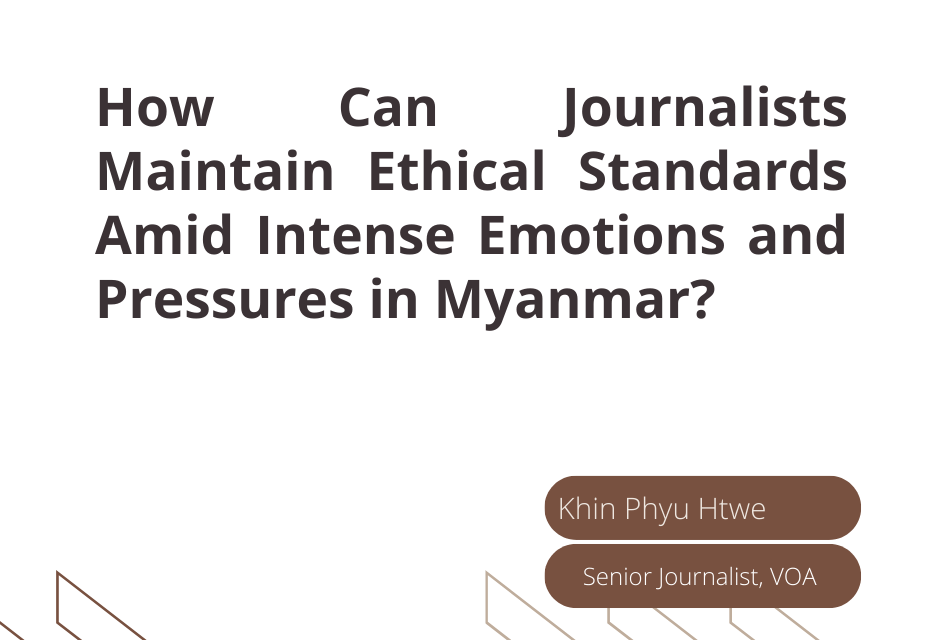
RAIN: Hello everyone! Welcome back to The Kaladan Post’s “Youth and Women’s Affairs program.” This week, we have a special interview segment with a well-known journalist and broadcaster from VOA, Ms. Khin Pyu Htwe, who is familiar to many of our listeners. Hello, ma’am!
Khin Phyu Htwe: Hello.
RAIN: Thank you so much for taking the time to join us on The Kaladan Post. To start, could you please introduce yourself and share what you are currently working on for our audience?
Khin Phyu Htwe: Yes, of course. My name is Khin Phyu Htwe. I am a reporter at the VOA news agency. At VOA, there is a women’s section. I am also the person who regularly broadcasts that women’s section once a week. So, as everyone probably knows, our VOA broadcasting services are currently in a temporarily suspended state. During normal operations, my role as a journalist involves various tasks. I work across different segments, sometimes as a producer, sometimes as an editor, and of course, as a regular journalist for the women’s affairs segment. So, hello to everyone! I’d also like to add that my participation in this interview is based on sharing my personal experiences and insights. I’m not speaking on behalf of VOA as an organization. Thank you for having me!
RAIN: Thank you! Before you entered the media industry, what were you involved in? What inspired you to join an international media organization like VOA, and what challenges or experiences did you encounter in the early stages of your career? Could you share those with our audience?
Khin Phyu Htwe: Sure. For me, VOA has been a familiar name since childhood. Growing up in Myanmar under successive authoritarian regimes, access to information was heavily restricted. To learn about our country or global events, we relied on radio broadcasts. When I was young, my older brother would tune into VOA, RFA, and BBC every morning. That’s how I became familiar with VOA. Listening to these stations provided not only news but also knowledge and insights about our country and the world. In 2002, I had the opportunity to come to the United States for a three-month internship, during which I visited major news organizations, including VOA.
It was a thrilling experience to see the places I had only heard about through the radio. At that time, I didn’t imagine I’d ever work at a place like VOA, but I was deeply inspired. Later, when I came to the U.S. to study, I wanted to take up a part-time job, ideally one connected to Myanmar. At that time, VOA was hiring, and I was overjoyed at the prospect of working there. The idea of working at VOA excited me because it meant I could stay connected to Myanmar and contribute to delivering meaningful news to the Burmese people. This feeling also came about because, as I mentioned earlier, we grew up listening to VOA, BBC, RFA, etc. So, growing up like that, we started to realize, by listening to these news sources, what was happening in our country, and why it was like this compared to other countries, that our country was missing something.
Questions arose, like why were our universities closed after we finished school? For me, even before I became a journalist, I was an activist for human rights and democracy. The fundamental reason for that was also that, by listening to these news agencies, I had the opportunity to know and see what was happening in my country. As everyone knows, since Myanmar has been under successive authoritarian rules for decades, press freedom was also blacked out all the time. Sometimes, we couldn’t even know exactly what was happening in our own region. So, if we wanted to know, we had to listen to the radio. And in doing so, there were even times during those dark ages when you could be arrested for listening to the radio.
But I learned from a young age about the impact of these major news agencies. So, when I was an activist, it was also primarily based on the information I got from these news agencies that I thought, “Oh, our country shouldn’t be like this. Other countries are developing like that. Why aren’t we developing? Why are we being oppressed? Why are universities and schools closed? Why can’t young people realize their dreams?” and so many other questions. Step by step, thinking about these things, I realized something was wrong. There must be justice, there must be freedom, democracy is important. For a country’s development, these things are necessary – these kinds of ideas.
From there, I myself also became an activist. Because of that, within my own family in Myanmar, my older brothers and sisters were also arrested and detained; they became political prisoners. At that time, I couldn’t stay in Myanmar due to the situation, so I sought refuge along the Thai-Myanmar border. Even during that period of displacement, I relied on radio broadcasts to stay informed about what was happening in my country and around the world. As I mentioned earlier, when I came to the United States to study, I needed a part-time job. When the opportunity arose to work at a respected news organization like VOA, I applied immediately and was fortunate to get the job. Initially, I worked part-time while studying. Looking back now, if you count both my part-time and full-time work, I’ve been with VOA for about 19 years.
RAIN: Yes. So, during the current Myanmar revolution, I believe journalists face significant challenges in obtaining news. Could you share the difficulties you encounter as a journalist in gathering information, verifying it, and delivering accurate news to the public in a timely manner during such a challenging period like the Myanmar revolution?
Khin Phyu Htwe: Absolutely. As a journalist, you have to adhere to certain responsibilities and ethical standards. When reporting a story, you strive to present it from multiple perspectives, ensuring it’s comprehensive and free from bias. This is something you learn over time. At the same time, no matter what job you do, I always try to approach it with sincerity and dedication. Through this process, I gain experience and learn a great deal about journalism by doing it. When it comes to the challenges we face, in Myanmar, freedom of the press has been virtually non-existent for many years. During periods of information blackout, uncovering the truth is incredibly difficult. Both those gathering the news and those providing information face significant risks.
For example, when reporting on incidents like a village being burned down, the entire people fleeing, or a battle breaking out, various situations like that, we have to gather information from multiple sources to ensure accuracy. Since, we are based internationally, contacting sources is complicated by communication challenges, such as poor internet or phone connections. Amidst this, we have to verify the news. You can’t just ask one person; you have to ask another. If you ask one side, you must also ask the other side. You have to ask to include all perspectives, all parties involved in the event. You can’t rely on just one source—you have to cross-check with others. If there are two sides to a story, you need to hear from both; if there are three or four perspectives, you include them all to ensure the report is balanced and comprehensive.
This process can be extremely challenging, especially due to communication barriers. Another major concern is security. When you interview someone, they might worry that speaking out could put them in danger. So, we also have to consider that from our side, and the person giving the interview also has to consider it. Sometimes they say, “I want to tell you, I really want to share, but please don’t use my voice.” For us at a broadcasting agency, if they say “don’t use my voice,” we have to figure out what to use instead. So, there are little difficulties like that. Another thing is, if we hear that the person who gave us news, after the interview, got arrested or something happened to them, it absolutely breaks our hearts.
So, such things happen. Therefore, gathering news is not like in a normal, free environment, a developed democratic country. It’s different inside Myanmar. Amidst oppression, we struggle hard to get a story out. And the story that comes out must also be accurate. We must ensure it’s not just one side’s voice and that the other side is not excluded. In such cases, you have to invest more heart, more time, and endure more hardship. So, that’s one aspect. Another thing is, since we are based in the United States, our main audience, the primary listeners, are in Myanmar.
Since we are reporting on Myanmar’s situation, we have to work on Myanmar Standard Time. So, when it’s sleeping time here, it’s midday in Myanmar. When it’s a good time for others to sleep here, we are awake. In the morning, we wake up around 2 AM. For example, to get to the office by 4 a.m., we have to wake up around 2 or 3 a.m. Public transport isn’t available at that hour, so we drive ourselves, which adds another hour for the commute. Despite these challenges—sleep deprivation, early hours—we’re so immersed in our work that we don’t even think about losing sleep or such difficulties. There are little difficulties like that. Only by waking up that early can we make calls at that time, their working hours. We work according to the Myanmar time-zone. There are little things like that, little challenges. But these are not major hardships. Compared to the situation the people of Myanmar are facing today, what we experience is nothing worth mentioning.
RAIN: Yes. So, as you mentioned, ensuring the accuracy of news involves a rigorous verification process and overcoming significant challenges to deliver reliable information to the public. At the same time, in the media landscape, misinformation and fake news often spread faster than accurate reports, especially during the revolution. Based on your experience at an international news organization like VOA, what standards and processes do you use to verify the accuracy of a news story? Additionally, what advice would you give the public on how to verify news and avoid falling for misinformation?
Khin Phyu Htwe: Especially in conflict zones, ensuring a news story is accurate and presented from multiple perspectives is a challenging task. You can’t just rely on one source. For example, if we’re reporting on a situation where a village was forced to flee due to fighting, and we want to cover the situation in that village, according to the standards of major news organizations, it’s not enough to simply ask a villager. Often, the entire village may have fled, leaving no one behind to interview. In such cases, you have to reach out to the nearest village to find out if any displaced people from the affected village are there and willing to speak. You have to track down people who can provide firsthand accounts.
When covering an incident, we also need to address who initiated the conflict—whether it was one side or the other. To ensure a comprehensive report, we must include all relevant perspectives. This means contacting individuals and organizations involved in the incident to understand how it started, its scope, and its impact. Questions like where it happened, who was responsible, and why it occurred are critical. These are basic principles that most journalists are familiar with. To achieve this, we strive to include all perspectives while maintaining impartiality and independence as a media outlet. We can’t rely on a single source; we need at least two, preferably three or four, to verify a story. If one source claims something, we can’t broadcast it immediately. We have to cross-check with another source to confirm its accuracy. Only after verification can we report, for example, “According to these sources, this is what happened.” In today’s world, with the rise of social media, anyone with a smartphone can share information or broadcast their perspective. This makes it harder for people to discern whether something is true or not.
The advancement of AI also plays a part. With Artificial Intelligence, you can even have photos that talk, so to speak. So, when such things happen, and considering our Myanmar people are not living in a free news environment, it becomes extremely difficult to critique and analyse which news is real and which is fake, especially with the proliferation of technology and social media I mentioned earlier. Verification is incredibly hard. So, the best way, if possible, is to rely on trusted major news outlets. The best approach is to rely on trusted, established news organizations. These outlets have earned credibility over many years, not just days or weeks. Their track record of accurate reporting builds public trust over time. I encourage people to prioritize news from such reliable sources and to critically evaluate the information they encounter.
On top of that, I want them to critically think for themselves, consider, and then accept how accurate it might be. I don’t want them to just see something on social media, Facebook, or YouTube and immediately take it as news. In news, there’s also mainstream media. As mentioned, there are trusted major news outlets, but on social media, there are also those who report news any way they want, presenting it in a way that pulls towards their desired narrative. There are also many beneficial aspects there. I’m not saying these things are good or bad; there are many beneficial topics. If used skilfully, it’s like medicine; if not, it can be harmful. I think it’s important to be mindful of this .
RAIN: Thank you. As a journalist, how do you balance personal emotions with journalistic ethics when reporting news?
Khin Phyu Htwe: As journalists, we must always uphold our ethical standards and never forget our role. To ensure this, we undergo mandatory annual training to reinforce journalistic ethics, reminding us to keep personal emotions out of our reporting. For me, this is particularly challenging because, as a Burmese person who grew up under authoritarian rule, I naturally harbour strong feelings against oppression. My family, friends, and community have also experienced the hardships of living under such regimes, so the emotional weight is significant. However, as a journalist, I have to set those feelings aside. Whether it’s reporting on deaths, conflicts, humanitarian crises, or displacements in Myanmar, these stories hit close to home because it’s my country.
Yet, when reporting, I can’t let my emotions take over—I can’t even cry, no matter how much I want to. For example, if I’m covering a story about someone being arrested or a village being burned, and it involves a friend, acquaintance, or relative, I still can’t let my personal feelings influence the report. When reporting on a conflict, for instance, if villagers say the military burned their village, we have to reach out to the military for their side of the story. We might ask, “The public claims the military did this. Can you confirm or deny it?” We have to contact the authorities or the military to get their perspective, regardless of our personal feelings. As journalists, we set aside what we like or dislike, what we feel or don’t feel, and focus on doing our job.
We must ask questions to all relevant parties, no matter how we feel about them. Sometimes, when covering arrests, it might involve someone I know personally. Even then, I have to remain professional and report objectively, ensuring all sides are represented fairly. Even if someone we know is arrested, we can’t take their side and report with bias. We have to present the story as it is. There are many instances where we must set aside our personal feelings and report objectively. VOA has a motto: whether the news is good or bad, it must be true. Guided by this principle, we’ve had to put aside our emotions and report the truth in many situations.
RAIN: Yes. So, the next thing I want to ask is, during this Myanmar revolution period, we see women’s leadership roles becoming significantly stronger. So, as a journalist, how do you analyse this aspect? And for women’s participation in various sectors of our Myanmar society to improve further, what do you think is still needed?
Khin Phyu Htwe: In recent times, we’ve seen women and young people taking on significant roles, not only in media but across various sectors, which is incredibly encouraging. Especially in the anti-coup movement since 2021, young people, particularly Generation Z, have been at the forefront, with many women playing key roles. In Myanmar, women make up more than half the population, and their contributions have greatly fuelled the momentum of this movement. Women and youth have consistently been at the forefront. However, when it comes to leadership roles, I don’t yet feel that women have gained as much ground as they deserve.
It’s not because women or young people lack the ability or qualifications—it’s due to the circumstances that limit their opportunities. I also believe more space should be given to these women and youth. Because if we say this is a movement involving the entire public, we cannot forget that half of that public are women. If we talk about public participation, we should acknowledge the participation and contribution of these women. While women’s leadership has increased compared to the past, I don’t believe it’s sufficient yet. If given more opportunities, I’m confident there are many capable women ready to step up.
RAIN: Yes. Similarly, you yourself, being a woman, have worked in international organizations like VOA. As a woman, did you face any specific challenges like that? If you did encounter such things, could you share how you motivated yourself and what kind of strengths you used to overcome them?
Khin Phyu Htwe: I believe female journalists in Myanmar likely face greater challenges. As women, they may encounter restrictions when working in conflict zones or navigating dangerous environments. In my case, working abroad, I haven’t faced those kinds of limitations as much. However, as a mother, I’ve had to balance raising children with my career, which sometimes meant I couldn’t dedicate as much time to my work as male colleagues might. But this is a temporary constraint. In Myanmar, women likely face more significant barriers due to societal and cultural factors. Here in the U.S., opportunities are more accessible if you’re capable, and I haven’t experienced overt discrimination or being left out specifically for being a woman. I don’t mean I haven’t encountered it at all. That said, inequalities still exist—for example, most editors tend to be men. However, in our Myanmar section at VOA, both women and men have been given significant roles, and I haven’t faced major gender-based challenges personally.
RAIN: Yes. So, primarily, there are many journalists who report from the field, risking their lives, not prioritizing their own safety, to provide the public with accurate news. So, we see that journalists’ security is extremely important. In that case, what kind of policies do major news agencies like VOA have to protect the psychological, physical, and digital security of field reporters?
Khin Phyu Htwe: This is a very difficult issue. In Myanmar, there is almost no security for journalists. It’s not just journalists; even ordinary citizens live in a place with no security. So, for us, our journalists inside the country work under truly difficult conditions. Journalists work knowing they could face danger at any moment. It’s heartbreaking, but in a place like Myanmar, where the military does whatever it wants, our ability to protect journalists is extremely limited. If someone is arrested, the most we can do is try to visit them in prison or provide minimal support, but beyond that, we’re often powerless. Journalists in Myanmar know the risks they face, yet they continue their work with incredible courage, which deserves immense respect. We don’t really have any protection to give them. Many news organizations, not just ours, face the same reality: journalists in Myanmar are constantly at risk of arrest, threats, or harassment. But preventing that in advance is something we cannot do much to protect them under this military dictatorship, where they do as they please. That’s all I can say/ That’s the harsh reality.
RAIN: Looking ahead to the post-revolution period, as a journalist, what kind of media landscape do you envision for Myanmar? What do you hope it will look like, and what are the key requirements for fostering a free and ethical media environment?
Khin Phyu Htwe: For a free and robust media landscape to thrive in Myanmar, we still have a lot of work to do. Decades of censorship and suppression have stifled journalists, yet despite this, Myanmar has produced many talented and brilliant journalists. Our people are not lacking in ability. To foster independent media, society as a whole must work together. In Myanmar’s oppressive environment, people understand the importance of free media, and we need outlets that are truly independent, free from any organization or individual’s influence, and committed to delivering accurate news.
Even during brief periods of openness, many media outlets emerged, but reaching a high standard of quality journalism still requires significant effort. This isn’t due to a lack of talent but because of systemic issues, like the breakdown of the education system under prolonged oppression. So, when all other aspects within the broader social fabric have completely deteriorated, there are many areas that need repair and improvement, and the news industry is among them. For the news industry to develop, the role of free media must be given more prominence and developed further. So, I believe once we reach an open era again, these media can achieve a lot. We have many truly capable and skilled journalism professionals in Myanmar. Furthermore, Myanmar people are not an incompetent ethnic group. ‘Myanmar people’ refers to all ethnic nationals in Myanmar. We all are not incompetent. Looking at the progress made during the decade of reforms, it’s clear that given the opportunity, our people can achieve great things. What’s needed is freedom from oppression, opportunities, and a collective effort to support ethical, independent media. I’m confident this can happen with dedication.
RAIN: As a final message, through this interview, what would you like to say to the Myanmar people enduring these challenging times and to the new generation of journalists standing for truth?
Khin Phyu Htwe: Myanmar’s people are incredibly hardworking and capable. Especially the younger generation—they’re exceptionally talented. I recognize their ability to seize opportunities and achieve progress. No matter where they are, Myanmar’s people, across all ethnic groups, have the potential to excel. They’re already skilled; they just need opportunities. But on the other hand, it’s about where our own interest lies, what we want to become. If you want to be a journalist, you must equip yourself with the necessary knowledge and skills.
This requires effort, but I believe you can do it. With access to the internet and phones, there are now many ways to learn easily, even online, without being there in person. Stay focused on your goals, dedicate time to your work, and approach it with sincerity. For journalists, adhere to ethical standards while ensuring your work benefits the public. With this mindset, Myanmar’s talented people can achieve great things. But if they do it with dedication and focus, it will be the best. Another thing is, as said before, our youth are already capable. So, if they exert more effort to correctly and best realize these capabilities, it will be very beneficial for Myanmar.
RAIN: Thank you so much for sharing your memorable experiences at VOA and your valuable insights as a journalist through this interview.
Khin Phyu Htwe: Thank you! I’m grateful for the opportunity to share my experiences.
Note: This translated text represents our effort to help international observers of Myanmar affairs gain a more accurate understanding of the actual situation in Myanmar. If there are any shortcomings in the translation, we respectfully request that you consider the original Burmese meaning as the authoritative version.
 English