
Salai Dokhar: Greetings to all our viewers tuning into *The Kaladan Post*. Today, we have the honor of hosting the chairperson of the Democratic Party for a New Society (DPNS) party. Our discussion will focus on the current state of the Myanmar revolution and the perspectives of neighboring countries and the international community regarding our revolution. First of all, let me thank you for giving us your time.
Aung Moe Zaw: Thank you very much for having me.
Salai Dokhar: Alright, sir. Let’s start with the first question. There’s a perception that the current revolution has taken longer than anticipated. Initially, some political figures predicted it would last six months to a year, urging people to hold on. But now, as we approach five years, why do you think this revolution has taken longer than the public expected?
Aung Moe Zaw: One key factor is that armed revolution is not something our people are accustomed to. It takes time to prepare and understand the process. That’s one aspect. Secondly, the military regime we’re facing is highly experienced and skilled in suppressing opposition. Throughout Myanmar’s history since independence, they’ve managed to weaken or control various resistance movements. They’ve been doing this consistently. The armed resistance by non-Bamar ethnic groups has been ongoing for a long time, almost since independence. Over this period, the military has ensured these forces couldn’t pose a significant threat, maintaining control until now.
However, with the Spring Revolution, it’s clear the military regime is significantly weakened. Morally and in terms of public support, they are at a low point. Even in terms of combat capabilities, they’re struggling. That’s why, regardless of what anyone says, the armed revolutionary movements are shaking the military’s foundation and pushing them back. Across the country—whether it’s the Kachin, Palaung, Wa, or in the south with groups like the KNU or KNPP, or in the west with the CNF and other Chin revolutionary forces—there’s a coordinated effort making significant progress. The revolution is actively pushing the military regime back, and that’s how I see it.
Salai Dokhar:: So, it seems the military junta is preparing to hold elections to extend their coup’s legitimacy for at least another five years. At the same time, they’re making gestures toward peace talks. Is this, as you analyzed earlier, an attempt to exploit our side’s weaknesses with confidence, or is it a sign they’re in a position where they can’t retreat? How do you assess this?
Aung Moe Zaw: My understanding is that they’re finding it difficult to retreat further. The election is their escape route. By holding elections, they hope to navigate a political path to maintain power. In reality, whether it’s the international situation or attempts at dialogue, all paths seem closed off for the military. To break out of this deadlock, they’re now talking about elections.
They likely believe that by pursuing this path, they can gain some relief or support from international actors—whether it’s China, Russia, or even India to some extent, or neighboring countries like Thailand. If they can hold elections, they might secure some assistance and break out of their current predicament. That’s why they’re preparing and pushing for elections as a way forward. That’s my assessment.
Salai Dokhar: So, the military junta is cornered and unable to retreat. On our side, to decisively defeat them, we need to keep pushing forward. However, it seems we still have some ground to cover. The National Unity Government (NUG) announced plans for a transitional government since the Spring Revolution began. Yet, progress hasn’t been as swift as the public hoped, and internationally, there seems to be less enthusiasm for engaging with the current NUG. Some analysts suggest the international community is waiting for a new transitional government. How much hope do you place in the NUG’s upcoming changes to decisively defeat the military junta? What’s your perspective on this?
Aung Moe Zaw: The Spring Revolution, from the very beginning, has been driven by the people themselves. It wasn’t sparked by a political party or organization but by a massive public movement. Even today, our people are the ones fighting against the multifaceted blockades and obstacles posed by the enemy. We’ve had to rely on our own strength to push forward. This revolution is truly about the people relying on their own efforts to keep moving ahead. The current state of the revolution has already made significant progress, and we must continue to push forward to achieve victory.
The NUG, as a political entity, may be relevant to us and could play a role in our efforts. However, on the ground, it’s the people who are doing the real work, relying on their own strength. Our diaspora communities abroad are also contributing as much as they can. With these collective efforts and cooperation, we must hold hands firmly and continue to push against the enemy to remove them. That’s my firm belief.
Salai Dokhar: Yes, what you’ve said reflects the reality. However, one recurring question, both internationally and regarding Myanmar’s current revolution, is the concern that if the military junta collapses, the country could fracture into pieces. There’s a perception that the National Unity Government (NUG) might not be able to manage the situation politically or establish a consensus or framework to hold the country together if the junta fully collapses. Some argue that because the NUG hasn’t achieved this yet, there’s a lack of full confidence in the revolution. So, how would you respond to this concern?
Aung Moe Zaw: Let’s look at the reality of the revolutionary movements. Today, in KNU areas, the KNU is managing and governing. In Karenni areas, the Karenni forces are managing. Similarly, in various regions, revolutionary forces are effectively administering their territories. I believe they have the capacity to govern their regions. If we aim to build a federal union in the long term, coordination and cooperation among these forces are absolutely crucial. For instance, cooperation between the KNU and KNPP, or between the KNU, KNPP, and northern forces, is vital.
These connections and collaborations with democratic forces within the country are extremely important. I firmly believe that these cooperative efforts have already made significant progress. Whether it’s the KNU, KNPP, KIO, or Palaung forces, their ability to work with the NUG and form alliances is critical. That’s how I see it.
Salai Dokhar: So, given the current state of the revolutionary forces, whether we call it a confederal system or self-governance, they are already taking full responsibility in their controlled territories. Does this mean there’s no need to worry about the country fracturing, and that a confederal design could transition into a federal system—a “coming together” federal model?
Aung Moe Zaw: In my view, the current situation is that our enemy is the military junta. The primary goal is to drive them out of our lands. For example, in the Rakhine region, it’s possible that Rakhine could become a distinct entity. Similarly, other states might establish strong control over their territories. These outcomes aren’t driven by our desires but by the realities of the ongoing battles. If we obsess over preventing these possibilities, we’d be playing into the enemy’s hands. Instead, Rakhine will fight to liberate Rakhine, Karen will fight to liberate Karen State, and Karenni will fight to liberate Karenni State.
Now, let’s take the Chin Hills, for instance. There are various forces there, and if they coordinate effectively to liberate the entire region, our progress will be much faster. The shape of the country’s future depends on the demands of history and its necessities. After the anti-fascist revolution and during the independence struggle, the Union of Burma was formed. But because that union wasn’t perfected, we’re facing these conflicts today. The current situation could lead to another turning point, and we need to be able to accept that, I think.
If we cling rigidly to textbook maps or historical frameworks, achieving our goals could become difficult. The demands of the people and the revolutionary forces today go slightly beyond the federal union we’ve discussed in the past. However, I believe the political leaders and organizations leading these forces have vision. I don’t think they’ll act in ways that scatter or divide our unity. That’s my perspective.
Salai Dokhar: Yes, alright. I’d like to ask about the current international context. As we approach five years of this revolution, we’re close to achieving a decisive victory, but the military junta has enacted emergency laws and appears to be regaining some ground. Coincidentally, with earthquakes hitting Myanmar, neighboring countries and the international community seem to be engaging more with the junta, using the disaster as a pretext. Does this indicate that the international community is shifting toward the junta? How do you assess this?
Aung Moe Zaw: I don’t see it that way. It’s undeniable that when an earthquake hits our country, our people suffer greatly. Any ordinary person or nation would naturally think about helping in such a crisis. Everyone knows about the political issues in our country—both globally and regionally. So, they’re trying to overcome these challenges by providing aid. But as you know, the military junta’s attitude and their response to international assistance are clear. It’s very difficult to reason with or persuade them, and the international community knows this well.
Because of this understanding, even if elections were held in our country today, suffering would continue—violence and loss of life would persist. The world knows that elections organized by the junta won’t resolve our political problems. Many are watching closely to see whether these elections will even happen. In ASEAN, for example, Malaysia is currently taking a leading role. They’re issuing strong warnings and engaging with various forces to better understand Myanmar’s situation. At the same time, they recognize that all these issues stem from the junta’s actions. That’s why they’re urging dialogue first, talk first, saying elections should come only after issues are resolved. That’s how I understand it.
Salai Dokhar: Alright. So, the international community engages with the military junta due to various circumstances, and there are countries that sidelined the junta entirely. However, among our neighbors, two major powers stand out: China and India. India, after Thailand, is the country hosting the largest number of refugees. On one hand, revolutionary movements along the India-Myanmar border have been strong since the revolution began. On the other hand, there are still organizational weaknesses. This has led to an influx of illegal activities, including drugs and other black-market operations, penetrating India, causing significant concern. Yet, India’s response to Myanmar’s revolution has been somewhat cold. While they provide immediate aid on border issues, there’s no systematic approach to fostering peace, and they seem to only engage with the junta on necessary matters. What’s your perspective on this, and how do you assess it?
Aung Moe Zaw: It’s clear that India’s primary goal is economic penetration into this region, aiming to connect with Southeast Asian countries like Malaysia through Myanmar. They want to establish trade routes through our country. Similarly, China is pursuing its Belt and Road Initiative, aiming to connect through India to expand globally. These are their core strategic objectives. Overcoming these dynamics will be challenging, but I believe there are ways to navigate and work around these circumstances.
Our people are absolutely determined to overthrow the military junta, and they’re actively pursuing this goal. However, as you mentioned, India’s stance, China’s stance, and ASEAN’s stance seem to be aimed at maintaining the status quo. While they pursue their own interests, it feels like they’re obstructing our efforts. But in reality, they know they can’t fully stop us. Look at Rakhine, for example. China sends its workers and forces to maintain control and protect their interests, like the gas pipeline running from Rakhine to China. At the same time, they’re pretending to support the junta while also backing revolutionary groups like the AA, Palaung, and Kachin forces to some extent. So, I want to say that these situations are creating a very messy and complicated scenario.
Salai Dokhar: So, we understand India as a major power competing with China. On one hand, the revolutionary forces don’t want China to dominate or control the situation and aim to reduce its influence. On the other hand, they’re striving for a federal democracy. These two goals align with India’s true interests, don’t they? Yet, India’s actions toward Myanmar’s revolution seem to prioritize engaging with the junta for limited gains. Would India benefit more by continuing to deal with the junta, or by cooperating with our revolutionary forces? If India were to support the revolutionary forces, what kind of assistance do you think they should provide?
Aung Moe Zaw: Whether it’s India, China, or a country like Thailand, they all know about the people who have historically held power in Myanmar. From Ne Win’s era to today, they’re aware of how these groups have governed the country. They know that these leaders are the reason our country is suffering and that their actions have caused ripple effects in neighboring countries. I believe they understand this. If they choose to ignore it, there will be consequences for those who do.
In reality, if our country deteriorates, it’s not good for China, India, or Southeast Asian countries like Thailand. For Myanmar to achieve political stability and foster economic and trade activities, the military junta must be removed. Neighboring countries and others need to realize this, and I believe they do. It’s not that they don’t understand. The practical challenges they face are hard for us to pinpoint, but those challenges are real. That’s what I’d like to say.
Salai Dokhar: For example, regarding support for revolutionary forces, Thailand has taken some actions, such as allowing certain revolutionary groups to settle and providing pathways for political discussions. However, India hasn’t even reached that stage. So, what specific types of assistance could India provide to the revolutionary forces without much difficulty, given how critical this support is for them? Could we discuss some examples?
Aung Moe Zaw: For instance, just the other day, we were hit by an earthquake. It’s clear that aid from India reached many of our regions. We’ve heard that it arrived. At the very least, on humanitarian issues, when international aid is provided, it often goes through the government. But in some cases, we’ve seen aid reach affected people directly. If they can manage this for humanitarian aid, I believe India could also provide direct support for political or economic matters to local organizations. They’ve done it before—recently, in fact. Given this, India and other neighboring countries have many ways to genuinely help our revolutionary forces, political groups, and suffering people if they have the will to do so. That’s what I’d like to emphasize.
Salai Dokhar: So, on the Indian side, whether it’s diplomats or those currently leading the government, when we ask why they aren’t supporting Myanmar’s revolution, they often point to 1988. They say India fully supported the revolution back then, but it didn’t succeed, and as a result, the military fell into China’s orbit. They claim to have learned from that historical mistake. However, on the other hand, China and Russia, with their veto power at the UN, can shield the junta from international actions it fears or secure aid it desires. No matter how much India supports or backs the junta, would the junta choose India over China and Russia?
Aung Moe Zaw: For both the junta and our revolutionary forces, China’s stance is extremely significant. In the international arena and in the practical context of our country—whether causing harm or fostering progress—China plays a more critical role than India. India, as a democratic nation, may have certain inclinations at the central level. However, controlling states like Mizoram or Manipur directly is quite challenging for them. You know how these states view our country and their attitudes toward us in current affairs.
Controlling or managing these states’ positions, like Mizoram’s stance toward us, is very difficult for India’s central government. They act based on their own perspectives. So, when it comes to engaging with Myanmar’s issues, it’s easier for a country like China to get involved. Moreover, in global politics, China is further ahead. That’s why, in Myanmar’s current political landscape, China is deeply involved—some might even say they’re directing Min Aung Hlaing. These are the realities, and that’s what I want to highlight.
Salai Dokhar: So, that’s your perspective. Instead of India engaging with a junta that’s essentially subordinate to China and compromising its own dignity, especially since their projects are currently stalled to some extent, wouldn’t it be more beneficial for India to support the revolutionary forces? Particularly, since these forces are effectively managing their regions and could build strong relations with India as neighbors. Doesn’t India, as a neighboring country, have some responsibility? At the very least, beyond humanitarian aid due to border issues, when the ground situation is insecure, wouldn’t it benefit India more to allow free political discussions in its border areas and support the revolutionary forces in regions adjacent to India to strengthen them? Wouldn’t that be better? What’s your view on this?
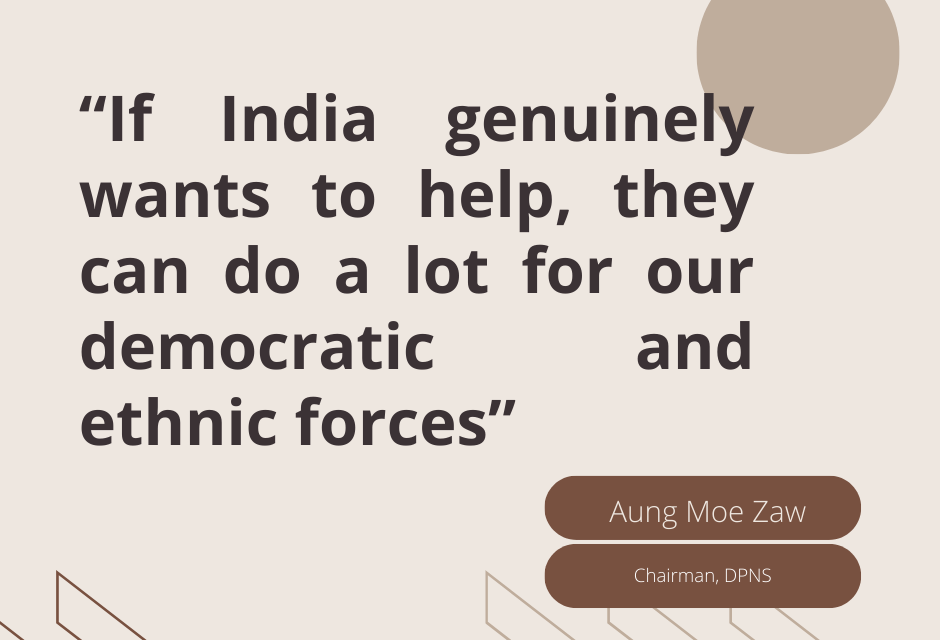
Aung Moe Zaw: Even with the earthquake, India provided as much help as they could, and they can provide practical assistance. Their aid has reached many areas, maybe not extensively, but significantly. So, the capacity is there. If India genuinely wants to help, they can do a lot for our democratic and ethnic forces. However, I don’t fully understand the BJP’s policies or stance. Back in 1988, it was their rival party that supported us. The attitudes of leaders like Rajiv Gandhi or the Congress Party toward our region and India itself were quite different from the BJP’s.
Currently, I don’t have a clear understanding of the BJP’s stance. It’s hard to gauge how much their policies differ from those of the past or how much they’re competing with China on the ground. Back in our youth, the Congress Party’s views were distinct from the BJP’s current stance, and it’s difficult for us to assess how far apart they are. We’re left speculating based on distant news rather than having clear, close-up knowledge. That’s the reality.
Salai Dokhar: As a final point, our revolution has now surpassed the length of a typical government term. So, to conclude, what advice or encouragement would you offer to the people about how we should move forward with strength?
Aung Moe Zaw: On behalf of myself, I want to express gratitude to all the people of Myanmar. It’s because of the people’s steadfast support that our revolution has remained strong up to this point. We’ve been able to continue our efforts to remove our enemy because of this foundation. The primary reason for our progress is the overwhelming support of the majority of our people. That’s the first point I’d like to make.
Secondly, when it comes to practical work, both our people and our comrades know that we face many challenges. There are numerous issues within our revolution. Regarding these challenges, I urge everyone not to lose heart. Support your close friends and comrades as much as possible, come together, and encourage one another. That’s what I want to say.
Another point I’d like to add is that our revolution is truly about creating something from nothing. We don’t have sufficient weapons, supplies, or resources, as I mentioned earlier. Yet, our comrades are doing their utmost to fight the enemy with what we have. For this, I humbly request everyone to come together and help in any way they can. Whether it’s asking for assistance or making a heartfelt plea, the struggle has been long. But if we fail to remove our enemy in this situation, our future generations will continue to suffer.
Therefore, in times like these, the most critical task is to remove our adversary. I earnestly urge everyone to stay resilient and work together to achieve this. Thank you.
Salai Dokhar: Yes, Sir, thank you very much for giving us your time.
Aung Moe Zaw: Thank you, thank you.
Note: This translated text represents our effort to help international observers of Myanmar affairs gain a more accurate understanding of the actual situation in Myanmar. If there are any shortcomings in the translation, we respectfully request that you consider the original Burmese meaning as the authoritative version.
 English