
Rain: Hello, sir. Thank you very much for taking the time to join us on The Kaladan Post’s Youth and Women’s Affairs Program. First of all, could you please introduce yourself, your name, and then the organization you are currently involved with, along with the roles you are playing? Of course, hello. My name is Stephen Shing Thang. The organization I am serving, now, is the Chin Defense Force – Kanpetlet. I am currently participating as an executive committee member of the Chin Brotherhood, and I am also a member of our interim council, the Interim Chin National Consultative Council (ICNCC). Yes, thank you. Yes, thank you. So, before the 2021 coup, what were you doing, and due to your work experience or circumstances, how were you motivated to become deeply involved in this revolution?
Stephen Shing Thang: Yes. Before the revolution, I was a Bible school graduate. After finishing Bible school, considering the situation in our Chin State and specifically in Kanpetlet, there were many students facing difficulties attending school, especially those from remote areas. Even before the NLD era, like other towns, Kanpetlet only had up to middle and high school levels (Grades 9 and 10) available locally.
Many villages couldn’t access or establish middle schools. So, it was a time when many students would finish their education after passing the fourth grade, dropping out of school. So, for those of school age who had passed fourth grade up to higher grades, who couldn’t afford to rent a house in town, couldn’t attend school, or whose parents lived too far away to care for them, we wanted to help. We did this by setting up something like a boarding house.
I was involved in that. We had to close the hostel, and then before schools could reopen due to COVID-19, the coup happened. Then, when the entire public started protesting against the military dictatorship, young people, regardless of religion or ethnicity, all came out to oppose the military dictator. So, I also joined through protesting. After the protests, when the SAC started targeting and arresting protest leaders, making threats, we formed the Township People’s Security. So, from participating in protests, to Township Security, and then eventually to armed resistance. That’s how I became involved. Thank you.
Rain: Yes. After the coup, during this revolutionary period, what military or political activities have you been involved in? Please also share the challenges and difficulties you faced during these activities.
Stephen Shing Thang: Yes. After the coup happened, politically, I wasn’t very involved. In terms of the revolution, I served as a Brigade Commander for CDF-Kanpetlet and participated as much as I could in my role. When the Spring Revolution began to oppose the SAC, we all came out armed with whatever weapons we had, like Tumi (traditional daos).
We didn’t form up, get training, and then fight; it was people who came out fighting with Tumi weapons after clashes had started, and we had to reorganize afterwards. So, in our township context, we tried our best to be as organized as possible. We believed that only through unity could we reach our desired goal, so we tried to prevent having three or four separate groups within one town. We participated and tried our best in that way. Furthermore, we also tried our best not just for our township or region, but for the entire situation in Chin State, for all of Chin to unite as one group.
As everyone knows, the Chinland Joint Defense Committee (CJDC) was formed. We tried to foster collaboration. However, the challenge we encountered there was a lack of building trust amongst ourselves. It’s not that we couldn’t build trust, but that we didn’t build it. So, each group wanted to lead from one side, didn’t trust the other organization, and also didn’t work to build that trust.
During our meetings in the CJDC, when we had disagreements and arguments, our chairman, U Thla Hei from CNA/CNF, once said that our arguing was good. He mentioned that the Chin people had never had a platform where we could argue and discuss issues concerning our Chinland so thoroughly, so this discourse was also beneficial. We tried our best to find solutions.
The challenge here is the inability to trust each other, the excessive number of townships among the Chin, and the emergence of too many organizations – these are issues we faced, militarily speaking, in the revolution. Politically, since the armed groups’ role has significantly influenced the revolution from 2021 until now, one could say the revolution is also political. Therefore, this failure to build mutual trust also impacts politics. So, we are still facing the challenge of not being able to unite. I see this as the biggest challenge.
Rain: Yes. As you have discussed, the main goal of our revolution is the fall of the Military Council (SAC). However, as this revolutionary period prolongs, we see issues like differences in opinion and such problems arising among revolutionary organizations. So, to what extent do you think these differences in opinion hinder our main goal of overthrowing the SAC? And how do you think we should best confront and resolve these problems?
Stephen Shing Thang: Yes. From my perspective, at the very beginning of the Spring Revolution, everyone, both inside Myanmar and abroad, who supported the revolution, hoped that Chin State would be the first liberated territory. We, too, not just in one or two townships, but across almost the entire Chin State, took up arms like Tumi and started the revolution simultaneously. If we, the armed groups, can reunite, then speaking specifically for Chin State, our common goal is the eradication of the SAC from Chin State.
How much has this disunity affected our common goal? Within the Chin, for example, Kanpetlet, Mindat, Matupi, and Falam are liberated. Tedim is not yet liberated. We, the Chin Brotherhood, need to continue working on that. Here, one thing I want to say is that the main reason for our disunity, speaking within the Chin community, is that Hakha and Thantlang are still not liberated. In the 2021-22 Spring Revolution, if we talk about funds, at a time when we in Kanpetlet could use around 50 million Kyat, CDF-Hakha and CDF-Thantlang, who could use around 300 to 350 million Kyat, are still not liberated. They had much more funds than us, could spend more, had more manpower, and had more weapons than us. I, serving as a brigade commander, would go to CJDC meetings and ask Hakha and Thantlang leaders for help with weapons, etc., and they did provide assistance.
The point is, they were far eqipped than us. But if we talk about whether they are liberated now or not, Hakha and Thantlang are still not liberated, even though they are closest to the CNA. So, this is due to our differences and lack of unity. By now, these areas should have been emancipated. Due to some differences of opinion, due to an inability to unite, because of these challenges, our common operating goal has suffered losses. This is an obstacle created by our disunity.
So, this is one obstruction caused by our disunity to our objective. As for how to continue finding solutions to these issues, it’s about trust between groups. Only through full responsibility, accountability, and collaborative action will we find a way out. My answer here is specific to us Chins. We Chins are currently trying from our respective sides to coordinate between the ICNCC and the Chinland Council to re-establish the Chin National Council (CNC).
But before reaching that stage, trust needs to be rebuilt. Those who are wrong should also admit it, not for personal gain or for the sake of any particular organization, but because it is for Chinland’s affairs, for the future of the Chin people, for the Chin national cause. If one is wrong, they must admit it, and then we Chins must rebuild mutual understanding and trust amongst ourselves. We need to talk openly about why we weren’t united in the past. Frankly, why couldn’t we unite within the CJDC? Why did it collapse?
Why are there such divisions in the ICNCC? The ICNCC is also not functional, and the CJDC on the other side has collapsed. The reasons for this… Groups must be open and frank with each other. If we are wrong, we must self-reflect on why we were wrong. We must self-reflect personally and organizationally. Only through this kind of re-evaluation can those who were wrong admit their mistakes, and since everyone wants Chinland to be liberated, wants the Chin people to be free, only by trusting and negotiating based on common ground can we move forward, reunite whether militarily or politically, and then achieve the freedom that the Chin people desire. We must rebuild trust like this. We must introspect. We must scrutinize our own organizations. Through this method, I personally believe we can rebuild trust. Yes.
Rain – Yes. As a next question, regarding Myanmar’s neighbouring countries like Thailand, China, India, etc., how do you assess their views and stance on the Myanmar revolution? And to what extent will their stance impact the success of the revolution? So, looking at the current responses and actions of these neighbouring countries, which country’s actions do you see as being the most supportive?
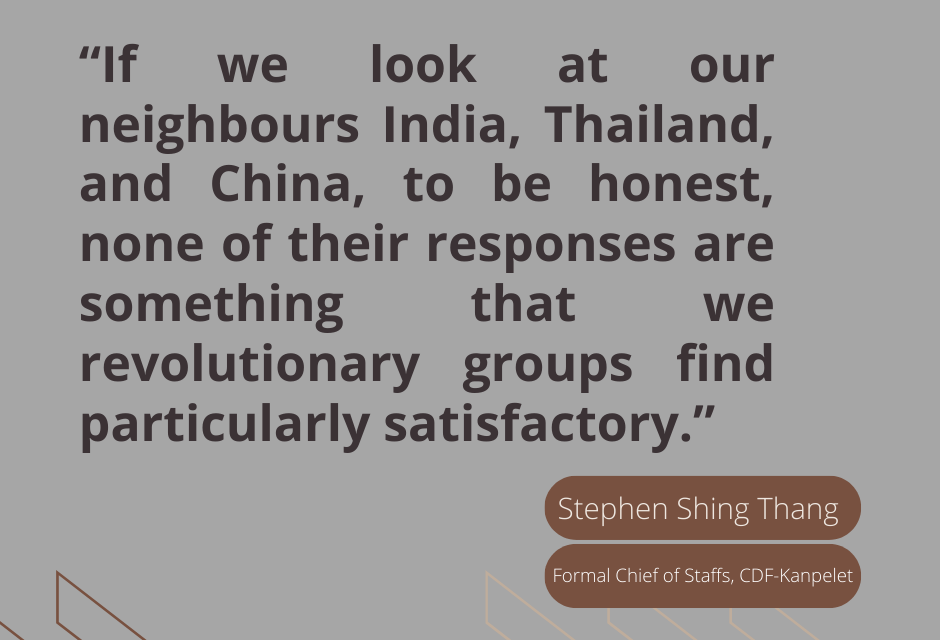
Stephen Shing Thang – Yes. If we look at our neighbours India, Thailand, and China, to be honest, none of their responses are something that we revolutionary groups find particularly satisfactory. However, their involvement significantly impacts the success of our Spring Revolution. With their cooperation, our work could progress much further, we could advance more. We all hope and believe that.
So, based on their current involvement, I analyse that even our revolutionary government, the NUG, when approaching these neighbours, seems to prioritize the West, Europe, and connections with the US, etc.., over them. When waging the Spring Revolution, the involvement of neighbouring countries… in any country, in any revolution, some revolutions even start in other countries. So, the NUG should have approached our closest neighbours first.
But perhaps they did approach them, we who are not involved might not know. From an outsider’s perspective, it seems they bypassed these neighbours. Later, we see them trying to reconnect and cooperate with bordering countries as much as possible. However, out of necessity, they do accept our war-displaced civilians/war-refugees. Even though there are meetings and talks with our revolutionary government, the NUG, in reality, I don’t see any country’s actions as being something we can point to and say we are truly satisfied with, that they strongly support the revolution. Yes.
Rain: Yes. If we look at this revolution, it wouldn’t be wrong to say it’s a revolution started by the youth. So, since you yourself are a youth, how do you assess the youth’s leadership role in this revolution? And please also tell us about the challenges and difficulties youth face when leading in these organizations.
Stephen Shing Thang: Of course. In the Spring Revolution, the most admirable aspect is the youth. Young people from every region have stepped forward and taken the lead. Regarding this leadership, speaking from my four years of experience in this Spring Revolution, a challenge I see is that veteran politicians, or let’s say veteran revolutionaries—the elders—not placing their full trust in the youth is the biggest challenge. Looking back at Myanmar’s history of revolution, the military has staged coups repeatedly.
Every time this military seizes power, revolutionary organizations emerge and resist. But what ultimately happens is that the military’s coup always succeeds first, and the revolutionary groups that fought always fall, always fail. So, this means that those who started the revolution since 1988 are still the ones holding positions and responsibilities in the revolution today. Because they are still there, the current youth, based on the understanding of how dangerous it would be if we failed here again, want to break out from this cycle of unsuccessful revolutions with full responsibility and accountability.
They believe that only by doing this, by breaking out from unsuccessful ideologies, unsuccessful theories, unsuccessful revolutions, can we achieve liberation quickly. It is at this time, when they are acting with full conviction, that those who have been involved in revolution for these past 70 years say things like, “We’ve been doing this for 70 years.” Whether it’s truly a full 70 years or not is something for all our people to judge.
What I mean is, in the 2021 Spring Revolution, when new youth emerged, statements like “You are still inexperienced in revolution,” “We have been doing this for so long, we have such seniority/ our tenure is this long ” reach the public. What does this damage? It not only denies the youth their place but also undermines the public’s trust in them. So, because of this, there is less space given to the youth, less trust in them. This leads to divergences and conflicts between the youth and these experienced revolutionaries. I see this as the biggest challenge faced by the youth who emerged after 2021 in the Spring Revolution. Yes.
Rain – Yes. So, before this revolution, we often saw restrictions on the participation and roles of our women. However, during this revolutionary period, we also see women leading and participating in various sectors. So, regarding women’s increased participation and leadership in these military, political, and administrative sectors, how do you assess it? And what further recommendations do you have for women to participate more strongly across all sectors?
Stephen Shing Thang: Yes. In this Spring Revolution, if you look across the entire country, you can’t say who has sacrificed more. And you also can’t say women have sacrificed more or men have sacrificed more. Everyone is contributing to the best of their ability. So, women, from their positions, are also striving to the best of their ability to fully contribute in the roles they can perform. Unlike previous unsuccessful revolutions throughout Myanmar’s history, post-2021, women, whether abroad or inside the country, are involved in the revolution—if not directly, then in CDM (Civil Disobedience Movement), where even young women are more numerous, if you look at the 2021 Spring Revolution statistics.
So, everyone is working together. Some women go beyond just CDM; they are interested in even the armed struggle, they attend training, they attend military training on equal terms with men. So, when it comes to going to the front lines, to be frank, from what I’ve experienced in Chin, just in our organization for instance, when we didn’t have enough weapons, we even had to select which men could go to the front lines. So, in that situation, women were left behind.
So, everyone is working together. Some women have even moved beyond the CDM stage and are interested in armed resistance, attending training, joining military training on equal footing with men. So, when it comes to going to the frontlines, to be frank, from what I’ve experienced in Chin, just within our own organization, due to our lack of weapons—when we didn’t have enough—even among the men, we had to select who would go to the front. So, in that situation, women were left behind.
They weren’t left behind because they were women, but because we only had one or two weapons, maybe two or three mortars. It just wasn’t feasible. When it was time to fight, when many male comrades were gathered, the women were naturally, sort of, left out in that way. So, it’s not that they were left behind because they are women, but due to various difficulties. In the Chin Brotherhood operation in Falam, as everyone knows, there is a woman in the CNO/CNDF Defence.
And we’ve seen them fighting on the front lines with snipers. It’s quite admirable. Even those not in CDM, who are just doing their jobs, support the revolution as much as they can. Those in CDM are strong in CDM, and they participate as much as they can in the armed struggle. So, speaking about the role of women, no revolution goes smoothly without funds. So, when it comes to fundraising like this, it’s actually women who strive more, give more time, and the organizers are mostly women.
From all angles, the role of women in this Spring Revolution is clearly visible. It’s truly commendable. For our future, whether in our future constitution or charter, we must genuinely incorporate the role of women into policy. After correcting the historical reduction of women’s roles over successive eras, and after establishing such guiding policies, we should continue to encourage women’s participation. That is my view.
Rain – Yes. I’d like to ask a little about the Chin Brotherhood’s statement. So, the Chin Brotherhood statement mentions establishing basic principles to unite all member forces and expand into a stronger, more cohesive army that can protect Chinland and the entire Chin nation. So, regarding this, some analysts say it’s impossible, while others are waiting to see how it will be implemented moving forward and with what principles. So, could you elaborate on what principles were established?
Stephen Shing Thang: Yes. Regarding the Chin Brotherhood’s “One Army”, it was decided upon with unanimous agreement at their on-ground meeting conference. “By the nature of this meeting, we have not arranged for that to be included in the agenda”. However, I believe that from the very beginning, every leader within our Chin Brotherhood has had the conviction to move towards this One Army. To relate this back, at the start of our Spring Revolution, we Chins each had the individual belief that we
For example, I was the Chief of Staff in CDF-Kanpetlet. But we didn’t use the title ‘Chief of Staff’. We used ‘Brigade Commander’. In Mindat too, even the Chief of Staff used the title Brigade Commander. What this signifies is that we intended for our entire Chin force to be integrated into One Army. Then, we would deploy defence brigades according to the needs of the township or region. That’s why we used the term ‘Brigade Commander’. The intention behind this terminology was our belief that we Chins should have One Command, One Army. I actively participated in the CJDC with this belief.
However, due to various reasons, when this was not successful, among our Chin Brotherhood leaders now, while the genuine, sincere desire for this One Army exists, we also know that making it work in practice will be very difficult. But I see it as a necessity, a common aspiration for all. That’s why it was decided upon at this on-ground meeting. The detailed policy aspects lie with the responsible committees within the organization, like the Chin Brotherhood’s secretariat. I cannot yet speak about the specific details.
But as a decision, it has been made. When we all publicize it for the people to know, some will support it, saying it must happen. Others will say it’s impossible, and there will be much criticism about why it can’t happen. More than it being impossible, we also know it will be very difficult. From the very beginning of our revolution, some said fighting with just Tumi (daos) wouldn’t succeed.
When it came time to launch counter-offensives with our own township-based forces, in 2021-22, we could only manage guerrilla warfare. Later, if we didn’t unite, it would be impossible, they said. Even when we united under the Chin Brotherhood banner, they said it wouldn’t succeed. When we conducted operations, the first Chin Brotherhood operation was in Kyindwe. The Kyindwe operation took a long time, they said we couldn’t capture it. They said the leaders were ineffective. Kyindwe isn’t a big city, it’s small, they said we couldn’t win it. We also had comrades who fell. We couldn’t hold the lines.
But in reality, it’s as the people see. Was it successful or not? So, regarding our Vaihmai now, we have thought a lot about it. More than whether it’s possible, we all know it will be quite difficult. But it must be done.
SAC also put out news, and there were various criticisms. But we managed to capture it. Not only that, we captured other townships one after another. They still said the Chin Brotherhood doesn’t work. Some said it was just a minority, not even a significant minority, a minority within a minority. But in reality, as the people have seen, has it been successful or not? So, regarding this Wunna Army now, we have also thought a lot. More than whether it’s possible or not, we all know it will be quite difficult. But we also must do it.
Looking at the SAC’s current situation, they are in a position to launch counter-offensives at any time. If we cannot operate with One Army, one command, then to what extent we can maintain and defend our territories is a question to consider. We are not doing this because it’s easy and we can do it. Whether it’s difficult or easy, it’s something that must be done. So, for those who support it, they themselves need to contribute and help.
We are not doing this because it’s easy and we can do it. Whether it’s difficult or easy, it’s something that must be done. So, for those who support it, they themselves need to contribute and help. Those outside who always attack us due to ideological differences simply say ‘it’s impossible’ lightly. In the future, we also want to be a federal unit, a federal state with full self-determination and the right to shape our own destiny.
For that, we cannot do it alone with our individual separate forces. Only if we can unite in this One Army, only if we can unite like this, can we shape the future we desire. So, rather than lightly saying ‘it’s impossible’, because it is so crucial for the Chins, during these difficult struggles, even those who say it’s impossible should participate. I want to reiterate that it is necessary to give as much support and encouragement as possible. Yes.
Rain: Yes. Furthermore, the statement mentions that principles were also established to draft foundational policies for alliance relations, international relations, economics, politics, socio-economics, etc. So, regarding these, with what kind of consensus and how do you plan to move forward with implementation? Please continue the discussion.
Stephen Shing Thang: Yes. According to the decisions of the on-ground conference meeting, we discussed and negotiated these matters. The policy on how to begin implementing this from the ground up is the responsibility of the assigned [body/committee] within the Chin Brotherhood. Once they present these detailed basics to the Chin Brotherhood, that would be the appropriate time to discuss the specifics. For now, in our meeting’s decision, it’s the general consensus, the agreement of all. The specific details are not yet finalized. Yes.
Rain: Yes. In the post-revolution future, what kind of society do you envision for the future Myanmar state? And specifically, to ensure that authoritarian systems do not continue to exist, what kind of policies do you think should be established to prevent this?
Stephen Shing Thang: Yes. In the future, if we are to rebuild the union… speaking personally, if we are to truly call it the Federal Republic of Myanmar again, then more than any specific system, because every individual is a human being, I would like to see a country with a system that fully embodies human rights for everyone within this union. For this to happen, when policies are negotiated between groups, they should be discussed and drafted with the participation of all ethnic groups living within the union, in an inclusive environment. That is my view, yes.
Rain: Yes. Finally, what would you say is the biggest lesson you have faced or learned during this revolutionary period? And what message would you like to send to the people of Myanmar and the international community?
Stephen Shing Thang: Yes. More than just in the Spring Revolution, even before it began, looking at the stages of our revolution as examples, I want us to build more trust among ourselves. Currently, all across our country, in every region, state, or division, there are many lessons to be learned regarding the aspect of building trust.
The biggest lesson is the inability to unite. For some groups, due to various reasons, their principles and stance waver. Some who gain stronger power also forget about mutual checks and balances. These things are not specific to any one area or place; it’s a universal observation. So, I want to say, finally, that we should take this as our biggest lesson. Both the people supporting the revolution and the organizations supplying it should never forget this lesson from past experiences until the revolution is successful. I urge everyone to remain loyal to this revolution and continue participating until it succeeds.
Rain: Yes. Thank you very much for your answers.
Stephen Shing Thang: Yes, thank you.
Note: This translated text represents our effort to help international observers of Myanmar affairs gain a more accurate understanding of the actual situation in Myanmar. If there are any shortcomings in the translation, we respectfully request that you consider the original Burmese meaning as the authoritative version.
 English