
Interviewer: Hello everyone. To all our dear viewers who always watch and support The Kaladan Post. Today, as part of our special program, we will be covering the success of the nationwide Silent Strike held on December 10th, Human Rights Day, and discussing the messages this Silent Strike sent to the enemy military council, as well as to the leadership of our revolutionary forces. For this special program, we have invited Ko Nyan Lin, who recently led a Silent Strike in Mandalay. Ko Nyan Lin, thank you so much for giving us your time.
Respondent: Thank you, Ko Salai. I am also very grateful for the invitation and the opportunity to speak.
Interviewer: Yes. First of all, how do you feel about the success of this Silent Strike? Because during this period, on one hand, there were threats and expressions of worry about these Silent Strike actions among people. On the other hand, we ourselves haven’t seen a Silent Strike for a long time. What emotions do you feel amidst this? And what would you like to say to the public about this success?
Respondent: The first thing I want to say is that I primarily want to express our respect and gratitude to the entire public. I genuinely feel this emotion deeply from my heart. The reason is that at this time today, the country is truly in a state of general crisis. The public is struggling immensely with poverty and livelihood issues. That’s the first point. The second point is that the oppression by the military group is also at an extremely intense period. To carry out this sham election, they are using various unjust laws to hand down long prison sentences; on the other hand, they are burning villages, attacking from the air, strafing, and so on. In a time of such severe general hardship and intense oppression, organizing a Silent Strike is truly a great challenge. It involves many challenges. However, today, seeing the public’s participation in this nationwide strike, demonstrating the unity and cohesion of the entire people, what I wanted to say earlier is that I mainly want to emphasize that such participation from the public amidst this situation and crisis is truly worthy of respect and gratitude. The second point is that today’s movement firmly demonstrated that the military group’s sham election is not the solution for the country, not the solution the people want. Therefore, no matter what methods the military group uses to commit violence, no matter how they deploy their troops, the entire public has clearly shown through today’s movement that they do not accept the path the military group is taking, they reject and oppose this sham election of the military group. This is undeniable. Such participation by the people also showed through today’s movement that they do not desire the unjust military service law, the unjust conscription law, that is oppressing the people. Therefore, we are grateful to the entire public for this unity and cohesion. We must firmly continue to uphold this unity and cohesion and carry on with the revolutionary journey. That’s what I want to say.
Interviewer: So, the public has truly fulfilled their duty once again. At this time, will the military council ignore the voice of the people and proceed with the election? Or, as some international analysts say, are there those within the military council who are on the softer line, or those advising them, including some who even participated in the revolution before, and the various political parties considering cooperating with the military council? For these groups, instead of the people, what message do you want to give? The people have clearly demonstrated. Precisely, what do you think this has shown to these groups?
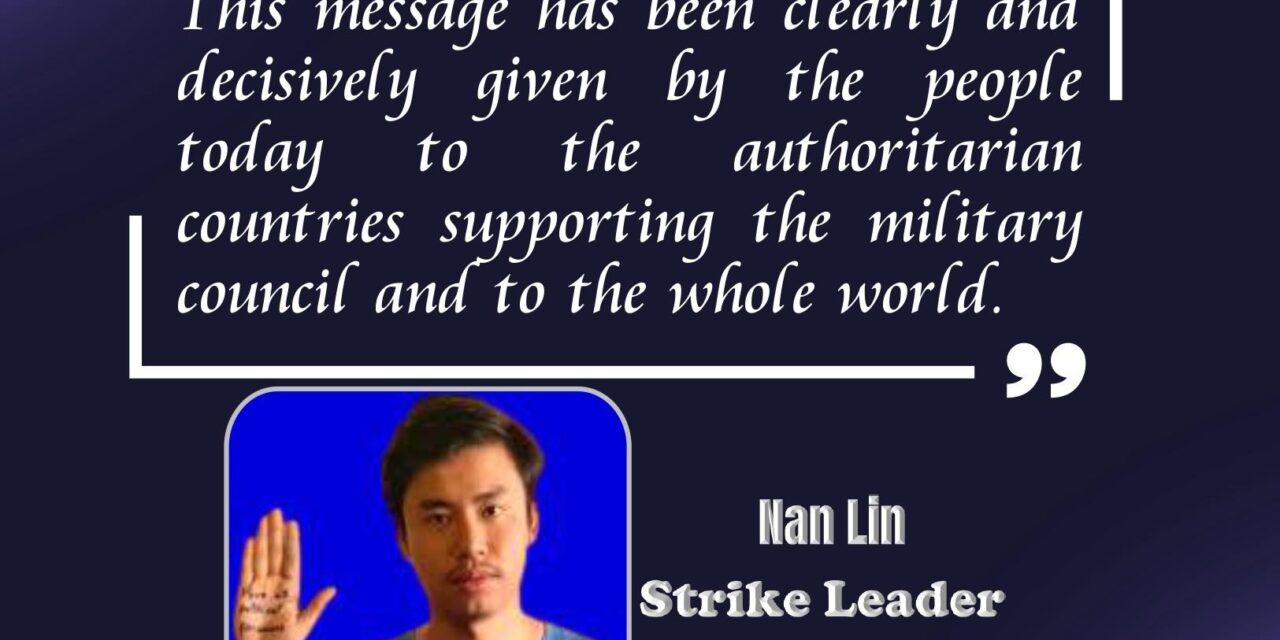
Respondent: I want to say that the message that change will come after the military’s election is no longer possible is extremely important. What do I mean by “no longer possible”? Every change the military group brings is not for the country or the people. They are changes made to maintain their power, to preserve the interests of the military generals. They only want change for themselves. For the country and the people, nothing changes. If you ask what will happen to the country and the people, the country will fall deeper into the abyss of poverty. The people will have to live permanently under dictatorship. That’s all that will happen for the people and the country. The people know this too. Therefore, by participating in today’s Silent Strike, the entire public has clearly demonstrated that they do not accept the path the military group is taking, they reject and oppose this sham election of the military group. This is undeniable. However, it’s certain that the military group has no other choice. Why? Because to whitewash the war crimes they have committed, the atrocities they are carrying out, they are looking for an exit through this election. So, what will they do? Even though they know the people do not accept it, they will shamelessly and without dignity forcibly continue with this election. After it’s done, who will come to power? Scoundrels, thugs. These are the ones who will become the so-called parliamentarians from the grand election, the so-called government from the election, and then they will attempt another deception. Looking at those who will come to power, they are only war criminals like Khin Nyunt, Aung Lin Dwe, Myo Zaw. These war criminals, even if they take off their military uniforms and wear civilian clothes, are still war criminals. Dictators are still dictators. So, one thing is clear: this election does not have the people’s mandate. Therefore, any result that comes from this election is not the solution for the country. Therefore, through today’s action, our people have also sent a message to the authoritarian countries supporting the military council: No matter what situations arise in our country in our struggle for democracy and human rights, we will continue to fight until we achieve our goal. This message has been clearly and decisively given by the people today to the authoritarian countries supporting the military council and to the whole world. No matter what situation arises, this is not what the people want. What the people want is genuine freedom and democracy. The message that we will continue to fight for that is, I believe, another important message from today’s Silent Strike.
Interviewer: Just before this public Silent Strike, without releasing a statement, you personally went into the field. Currently, there are arrest warrants with monetary rewards being announced for your capture. Even we, when watching the success of this Silent Strike, felt like tears were about to fall seeing how strong the people’s will still is. However, the strike forces and those responsible in the media are not yet institutions that can systematically realize the people’s will. So, at this time, amidst many criticisms, and with groups like the NUG and ethnic armed organizations also facing these, and earlier in our media analyses, there were views that the people are becoming demoralized about the revolution, that the public is getting quite tired. Yet, the people have surpassed these views and demonstrated defiance against both the military council and the adequacy of the revolutionary leaders’ leadership. So, what would you, Ko Nyan Lin, openly say to the leaders primarily responsible for fulfilling the people’s will, based on the success of this Silent Strike?
Respondent: The first point is that before today’s great Silent Strike, some, including the military group, thought they had gained the upper hand. The military group thought they had gained the upper hand. But today’s Silent Strike gave the message from the people that the military group can collapse and be destroyed at any time. In a time of such severe oppression and hardship, such massive participation by the people is a real threat to the military group. No matter what they do, no matter what kind of deceptive shows they put on with various situations, the people are not confused. The people clearly know what they must do and are continuing forward. We believe the military group received that message today. The second point, as Ko Salai also mentioned, is that the people have fulfilled their duty. It’s true, the people have fulfilled their duty. On the other hand, if we talk about the revolution, we started from zero. Now we have reached another stage. The revolution has reached a stage. However, the further the revolution progresses, the more problems and challenges increase. In the beginning, we started from a zero setting. Now we truly have controlled areas, administered areas, governance structures have emerged. There are many areas and regions where revolutionary forces have daily interactions with the people. However, our revolutionary forces do not yet have the capacity to fully manage these situations. We must also openly say that within our revolution, there are mistakes in actions, mismanagement, these problems also exist. We cannot deny this. We ourselves see these, and the people also see them. Despite such a situation, the people are holding onto their faith and hope and participating in struggles like today’s. We can definitely say that the people have extremely fulfilled their duty. So, the people have fulfilled their duty. The message that the revolutionary forces must fulfill their duty, that it remains to be fulfilled, has also been given by the people today, I believe, I feel that way. “Alright, we have done our duty. What will you do?” The people are posing this question back to the revolutionary forces. So, the revolutionary forces have a need for leadership. Until now, the revolutionary forces including NUG, NUCC, have been able to provide clear, firm, and strong leadership to the people. Reforms have begun from the NUG government side. We welcome such steps being taken. But that is not enough. The people are demanding more, the revolution is demanding more, we believe. For our revolutionary forces, for our strike forces, we must strive and work harder to build a broader, stronger, truly revolutionary framework capable of providing strategic leadership. That’s the first point regarding leadership change. The second point is that while it’s true the revolution has reached a stage, a journey, to end the military dictatorship, we must create a situation beyond this, we must do more work. Over the past five years, we have been striving to topple the military group. However, what we must accept is that the revolution is not a short-term journey. We also want to say that we can no longer give false hope or misleading messages to the people that the revolution will end this year or next. So, since the revolution is not a short-term journey, will the revolution be long? Will the revolution become a protracted saga? We cannot let that happen either. The longer the revolution lasts, the more challenges it will bring for the country and the people. To put it bluntly, the military dictator is consuming and destroying all the country’s resources for the sake of maintaining power. We will have to rebuild these. So, while understanding that the revolution is not short-term, we must also ensure it does not become a protracted saga. We must struggle with all our might, with all our ability, to further build the strength and resilience of the revolution so that we can firmly fight against the military dictator’s upcoming so-called civilian authoritarian government. We must provide stronger leadership. To reach that stage, we must strive and work harder. Only then will the people have greater trust in our revolutionary forces. Otherwise, we cannot accept becoming a part of history where the people fulfilled their duty but we failed to fulfill ours, failing to reach the desired destination. That’s what I want to say.
Interviewer: Yes. Among those points, our people also speak up, make demands, and the NUG President himself also makes demands. And political analysts, groups that analyze politics, also demand that leaders need to come forward practically and act. In that context, when we, the strike forces, started, before any official announcement, taking major risks, the strike leaders themselves went into the field, especially in Mandalay, the city with the tightest security, not on the outskirts but in the city center, and practically demonstrated action. From that time, looking at it, it brought the hope that it would be successful. Why? Because I feel that when the people see that our leaders themselves are carrying out such movements, it sets an example. If the strike forces merely issued statements and then led, I imagine it would only succeed if it were going to succeed. So, based on these, the analysis I want to draw is: currently, some of our leaders seem to be mostly abroad, while others, though they may be in liberated areas, citing security reasons, have very little contact with the people. When such analyses emerge, how can we, we revolutionaries, better take to heart the people’s demands for the future and act? Regarding that part, I’d like to ask for your advice.
Respondent: Our current leadership reform—leadership transformation. When I say leadership, I’m not pointing fingers solely at the NUG. I’m not pointing fingers solely at the NUCC. We need to properly reform and transform the various levels of leadership within this revolution. I have been carefully reflecting on this four- or five-year journey. Us strike forces. What are our own weaknesses, what do we lack? I have been analyzing that. After analyzing, to be able to move forward by learning from the experiences of the past four years, our strike forces themselves are also trying. As you know, Ko Salai, our strike forces, so to speak, are rich in methods. Rich in tactics. But our reliance on those methods, mobilizing and motivating the people, is significant. “Do a Silent Strike, do a flower pot strike,” and so on, “beat drums.” We are rich in methods. But our strike forces cannot connect these methods to a strategic level. That is our weakness. We need to correct this weakness. We are trying to correct it as well. On one hand, what we talk about is opposing the military dictatorship, eradicating the military dictatorship; on the other hand, building a Federal Democracy. So, we need to work on eradicating the military dictatorship, and simultaneously, we also need to genuinely practice and build this “Federal Democracy” concept among the people, among our revolutionary forces. Federal Democracy won’t fall from the sky after the revolution ends. It won’t sprout from the ground. These are exercises that must be practiced and built. Democratic exercises must be practiced and built in our daily lives, in our actions. In that regard, we ourselves are weak in practicing, building, and then organizing the people. That is the organizational weakness of the strike forces, as mentioned earlier. We see this weakness. We will also strive to correct it. Similarly, as we must correct it, on the other hand, regarding the leadership transformation—what reforms are needed? What we are primarily pointing out is that we now have revolutionary territories, controlled territories. The taxes, resources obtained from these territories need to be managed systematically. So far, I see the National Unity Government still has shortcomings in this regard.
Second, the People’s Defense Force (PDF) under the National Unity Government needs to be built more systematically into a more disciplined military force. We have always talked about the need for a strong Code of Conduct (COC). But up to now, we haven’t seen such a structure being built. That’s the defense aspect. Another is administration. Although we talk about public mobilization, what the people see and interact with daily are the PDFs, LDFs, and such in front of them. They are assessing the revolution based on these. Therefore, even these administrative groups and defense groups closest to the people need to be aligned with the people’s will, capable of providing services to the people, capable of becoming a framework that organizes and builds up the people. The current situations are, frankly, quite concerning. Therefore, to prevent such a situation, to change those perceptions, systematic administrative sector reform is necessary. This is us pointing out the points that need to be addressed in the National Unity Government’s current reform efforts. When doing that, we believe both people and policies need to change. For some positions, like the Prime Minister, we need stronger, more resolute leadership beyond the current level. We need such individuals. So, we will have to watch how actual, practical reform will happen in these sectors.
Currently, my understanding is that this is Phase 1. The first part of the reform. In the first part, it’s said that they are doing internal reform, as those responsible in the NUG government are also stating publicly. Then, Phase 2 will involve reforms done with the participation of other revolutionary forces, ethnic forces. That’s my understanding.
So, regarding the current Phase 1—the first part of the reform—frankly speaking, we are not satisfied. However, doing something is better than doing nothing, so I must welcome the fact that they have started doing it. I welcome it. But I’m not satisfied. It’s insufficient. So, how will Phase 2 transform? How will it become a leadership model that can resolutely lead the revolution, resolutely lead the people? How will the grassroots mechanisms mentioned earlier be reformed to fit the Federal Democracy model? The people are already asking questions, are watching. We also, to ensure those reforms become practical, effective reforms, we, for our part, will continue to apply pressure, give impetus. That’s what I wanted to say.
Interviewer: Finally, on a slightly different note from the beginning—what do you want to say to the international community? Especially neighboring countries like India, China, Thailand, etc., which include groups poised to welcome the election results. Having seen this Silent Strike, what should they do?
Respondent: As you know, Ko Salai, the current world system is what? It’s a world system based on interests. Interests compete. Frankly, it’s a world system prioritizing one’s own interests over standards or principles. Our revolution is also navigating through such a situation, one could say. Take China, for example. To speak openly, do they like Min Aung Hlaing? Probably not. However, they also do not want the collapse of this military group. To put it bluntly, China does not want to see a victory narrative where our Myanmar people, our revolutionary forces, win. So, because they don’t want to see that, on one hand, they play to prevent the military group from collapsing. On the other hand, they play to ensure the revolutionary forces do not gain the upper hand. In other words, they hold both sides and try to dominate Myanmar for their own interests. That’s how I see it.
Similarly, looking at other countries, I see their approaches to the Myanmar issue are also largely based on their own interests. The kind of stance, support, and practical assistance that our people want, that our people are demanding—we have not received that to this day. Despite not receiving it, our people are continuing to struggle with their own strength, their own unity. This Silent Strike is sending that message. So, if they truly respect our Myanmar people’s fight for freedom and democracy, then give practical assistance to our revolutionary forces. I want to send the message: Please, countries around the world, show stances and support that align with the will of our people, our public.
Interviewer: Thank you very much, Ko Nyan Lin, for giving us so much of your time and analyzing our people’s Silent Strike.
Respondent: Yes, thank you, Ko Salai. I am also grateful for being given this opportunity to speak, for the invitation.
Note: This translated text represents our effort to help international observers of Myanmar affairs gain a more accurate understanding of the actual situation in Myanmar. If there are any shortcomings in the translation, we respectfully request that you consider the original Burmese meaning as the authoritative version.
 English