
Interviewer: Salai Dokhar (Editor-in-Chief, The Kaladan Post)
Interviewee: Thinzar Shunlei Yi (Human Rights Activist)
Editor-in-Chief: Shunlei, first of all, I want to say thank you for giving us this time. So, first of all, many of us already know, but to become more familiar with the revolutionary people, what has Shunlei done before? And also, with what purpose are you actively participating in this revolution now? Please reintroduce yourself briefly.
Thinzar Shunlei Yi: First of all, thank you for inviting Shunlei. Personally, for the past fifteen years or so, I have been interested in the political and social conditions, the various situations in Myanmar. As a teacher myself, I thought it was necessary to tell the children I taught about Myanmar’s political situation. So that if these children asked, I could answer, I myself also studied with interest. When elections started in Myanmar, around 2010, I worked as a volunteer, observing what election observers did. So, based on that experience, through doing charitable work, I got involved with politics, you could say. When doing charity work, the main thing was teaching children, and then about teaching children to teachers. I taught teachers at monastic schools. While teaching like that, what I saw was that the children in big cities like Yangon and Mandalay weren’t children from Yangon or Mandalay. There were many children from places like the Arakan region, Kachin region, and Shan region. They were often orphans. So, that became a big question for those of us in Yangon who were far from politics. Why are so many here? When you ask the children, they don’t know Burmese well, and then their parents have passed away in these wars and conflicts, they’ve become orphans, they’ve been separated – we ourselves saw this. The subsequent question was, why did this happen? From the thought that children don’t deserve this, starting political revolutionary work. To put it simply, I was interested in youth affairs. Since youth under 35 make up over 60% of Myanmar’s population, I started as a youth affairs activist. Then, efforts for youth policy development. When I reached about 24 years old, as I became more interested in politics myself, I reduced youth affairs work. After reducing that, we worked on village tract reforms, ward/village tract administration, these governance sector reform activities. Especially to establish democracy at this most basic community level, the role of village administrators is important. So, to legally protect the ten-household and hundred-household heads, to enhance their role, I continuously did advocacy in parliaments on these legal aspects. So, after that, to put it briefly, it was advocacy work on youth affairs and local government issues. Connecting with international and domestic media, and then speaking with other partners. I mainly led and mobilized these advocacy aspects. After the coup, the work we do hasn’t changed much. To speak of the topics we were discussing, the work we were doing, it’s human rights, democracy, freedom of expression. We stood up for these ourselves, defended them ourselves, stood together. Now, I can say we have the opportunity to work more broadly with our revolutionary people. There isn’t anything particularly new or extraordinary being done. However, the people we get to work together with have changed. For example, before, if we talk about doing revolution, we mostly joined people from ethnic minority sides or from oppressed sides. And then laborers, farmers’ unions, students, these forces were prominent. In the aftermath of this Spring Revolution, more Bamar majority people who haven’t experienced conflict have joined. And then soldiers and police themselves have joined the revolution. And then businesspeople, and then from various successive sectors, sports, arts, education, these people, when we get to work together with many of them, our work has indeed become more extensive and diverse. So, to summarize, our main work is to support the continuation and survival of this non-violent civil disobedience movement domestically through technical and financial support activities. Along with protecting women and minorities, another aspect is work demonstrating unity and solidarity. It can be said we specifically do these types of work.
Editor-in-Chief: Yes, going along with this discussion, if we look at it, before 2021, it can be said that many young people had very little participation in political activism. Even those who actually participated were criticized in various ways, like whether these youths just wanted seats, etc. Instead of helping and promoting them, those who mobilized young people were blocked and criticism was even greater. That’s the situation Shunlei came into. So, now, in entering this Spring Revolution, every youth has become a leader in their respective groups. They lead and then participate in the revolutionary movement. So, as someone who has been active in political activism and social work since before, do you think the hopes for the outcome of this revolution are the same as those of the youth who have now started in the revolution? Also, while currently participating in the revolution, what kind of outcome do you wish for the revolution? Can you discuss and analyze that?
Thinzar Shunlei Yi: To tell the truth, even when we worked with fewer people before, let’s say there were only ten people, among those ten, there were still differences in thought. For example, even if they accepted minority issues, there were differences in political ideology on how to carry out rehabilitation work for these minorities. To put it simply, from that experience, I understood that being in complete agreement is difficult. We thought we would gather youth on one platform, connect everyone, coordinate, exchange, operate at a national level, yet even among our youth, the work they want to do is different. So, whether civil society organizations or youth themselves, our public has always been diverse and varied. To put it simply, ideologies and methods of operation differ. From the thought that they must always be on one side, one thing, they engage in different actions, participate with different ideas. We came to accept that this is the essence of democracy. In the aftermath of that, now in this Spring Revolution, the people participating are very numerous. To put it simply, even in the previous era with fewer people, we had differences, so now with more diverse people, and with different experiences. When past experiences differ, being of one heart and mind is quite difficult. Also, when we talk about being of one heart and mind, to what extent is it one heart and mind? We have discussions internationally, they say things like ‘you in that revolution don’t unite much, don’t see unity, each person does their own thing, each village has its own way, each village has its own chant.’ At that time, what I want to question in return is, whether youth, civil society organizations, women, or these armed defense forces, when we talk about unity, what unity are we talking about? In Myanmar up to today, until this time, we have never encountered a movement as strong and uniformly opposed to the military junta. Our methods of opposition may differ. Some take up arms, some strike, some advocate internationally. Methods and styles may vary, they differ based on one’s strengths. However, not liking military rule, not accepting the military coup, these are basic commonalities. I have not seen a louder and more unified unity than this. So, I see this as the best reason to further support and participate in this movement going forward. So, in this diverse Spring Revolution, with the single point of not accepting the military dictatorship, I can say our unity is great. However, how to fight the military junta may differ. What they want after the military junta ends may also differ. So, currently, there’s the three-finger salute, the three-finger salute is considered the main demand of the revolution. And then, at the start of this revolution, especially in the first six months, the public’s chants, demands raised during the Spring Revolution’s first six months, if reviewed, there are three common ones. One is the complete eradication of all dictatorship. Another is the abolition of the 2008 constitution, the 2008 constitution drafted by the military junta. Another is the building of a federal democratic state. These three points, I see, are the common thinking and objectives in this revolution. In the Federal Democracy Charter as well, I see these three points included as objectives. And then other forces, whether in the NUCC or not, if asked, these three points are unwavering. So, these three points, I see, are the basic common thinking and aspiration of the various groups participating in this Spring Revolution. Other beliefs, like whether one thinks liberally after considering politics, or thinks more right-wing, or left-wing, these may have differences. However, the uniform opposition to the military junta, I see as a common spirit and belief.
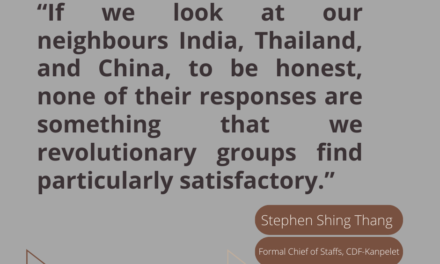
Editor-in-Chief: Yes, in the earlier part of our discussion with Shunlei, we also touched on how the international community sometimes criticizes the revolutionary forces based on ideological differences or divergences in positions. So, with that as a connection, what I would like to discuss more broadly is that, currently, if we look at our neighboring countries and the international community, their stance on the Myanmar revolution does not seem satisfactory, to put it roughly. So, particularly regarding the democracy movement within Myanmar, including the neighboring countries, how do you view the international community’s response? From Shunlei’s perspective, is there satisfaction with it? Please discuss this as well.
Thinzar Shunlei Yi: During the 2021 Spring Revolution period, I think we saw the true face of our neighboring countries. We realized and saw things we hadn’t before, hadn’t heard, couldn’t study to that extent. However, during the Spring Revolution period, we had the opportunity to engage from various angles—what India is doing, what Thailand is doing, what ASEAN is doing—despite language barriers. The main problem we faced while doing this advocacy work is that we don’t know much about each other. The people of Myanmar also don’t know much about these countries. And the people of those countries also don’t know about the Myanmar issue, except maybe as an ASEAN member country or the situation at the border. We realized we don’t know, and they don’t know. So, the big question for me became, why are we so distant? Following that, what I see arising from this lack of knowledge, lack of connection, and inability to link up, is that political decisions are no longer based on the people, but only on their own power, only on their considerations along their borders. They see only a small fragment of what they know or see. Another thing is, by their very nature, we also came to see that their democracies are not genuine. That gave us quite a chilling feeling. Why chilling? Because no matter how much we fight for democracy and human rights, even if Myanmar becomes independent, if our neighboring countries have problems to the extent we desire for Myanmar, our own security will also be affected, I must say. The world has become a village, and we must always interact; if there’s a fire next door, your own house won’t be peaceful either. That’s the idea. From that, I also came to see that democracy, human rights, in any country, are interconnected and equally important. From that thinking, I believe we must do much more work on regional solidarity and regional awareness-raising. To put it simply, the diplomatic affairs, political considerations, and military considerations of those countries all differ from the considerations of our people. There, things like the ASEAN Five-Point Consensus do not reflect or represent the current situation of the people. We see such things. These gaps, I think, need to be gradually narrowed through work. Only by doing so will it be sustainable, I believe.\
Editor-in-Chief: Earlier, when analyzing including ASEAN countries, especially neighboring countries, currently, among our neighbors, India and China are real world powers. Then, countries like Thailand are also well-known countries in the world. So, the participation of these countries is currently evident. But then, the cooperation of these three countries seems to be done in a way that prioritizes SAC (State Administration Council), we see such criticisms. And then, Bangladesh neither helps nor criticizes, seems to remain silent, we see that pattern. Except for the Rohingya issue. Laos seems similar to Bangladesh. Given the current state of our revolution, could you give an overall analysis of which country’s cooperation is the most beneficial? For example, to add, during a broader discussion, for instance, Laos, although it doesn’t help us, it also doesn’t help SAC, so we might need to understand them more, should we analyze it that way? But actions that seem to help while constantly giving political legitimacy to SAC… with such give-and-take, immediate airstrikes increase. Given such criticisms exist, what form of support is currently most beneficial for the Myanmar revolution? How should the international community help us? Please base your analysis on that.
Thinzar Shunlei Yi: Countries have different priorities. And their current positions are different, we see. For example, the EU or others, they have uniformly established things like currency, you know, agreements, parliaments, such things exist. Here in Asia, we are quite diverse and varied. If you look at political systems, they are not uniform. To put it simply, what we face is that in many Asian countries, when a neighboring country faces such a crisis, how to intervene, how to approach and respond, they are reluctant. Number one, they themselves face many problems. At a time when they themselves haven’t solved those problems, they are quite hesitant to play teacher or interfere in others’ affairs. That’s just an observation. I always ask the question why, why don’t they act? However, if we look at our current situation in terms of responsibility and capability, and then influence, which country can exert pressure or influence on the current military junta with its political system, we only look at that. So, if we define who has the most responsibility, we might want to define it that way. Defined that way, China has responsibility, India has responsibility. These two countries are the largest in Asia. India is a democratic country. China is not a democracy. At that point, its wealth, its economic power, India’s status as a democratic country—these, in my view, make them the most responsible countries. These most responsible countries themselves, instead of using their power for effective change, only look out for themselves, think only of protecting themselves from that basic consideration, and don’t consider others. There is no solidarity between nations. That’s one. Another thing is that India and China are also rivals. Being rivals, as for how to address such intra-Asian problems, I think Asian leaders also lack clear and precise problem-solving methods. As long as they themselves are not part of the problem, I should be grateful. So, looking at Thailand’s considerations, Thailand, I must say, has a bamboo policy. When the wind blows from that side, it leans this way. It has always worked with many pages in that pattern. So, even if Bangkok’s diplomats have one kind of thinking, those actually working on the border, the military, police, might have a different way of thinking. So, Thailand is very flexible and engages with the coup military as well as accepts groups like NUG, NUCC. However, it’s not giving official recognition. It’s uniform as well. India, for instance, although it can accommodate and contain activists, those participating in the resistance in places like Mizoram, in other mindsets, it’s a different pattern. But overall, in responding to the Myanmar issue, I wouldn’t give high marks to any country. I don’t see any country doing exactly what should be done. That’s also why, for four years until now, while the people of Myanmar are being killed daily on their own, the military is growing and remains brutal. That’s because of the failures to do what should have been done from the very beginning, and they will have to face this big problem until now. If they cannot properly control the Myanmar military, it will grow even more. That growth could reach a point of becoming a danger even for those countries themselves. Whether they consider this, I don’t know. But to put it simply, countries are different. Two countries have primary responsibility. They are the two largest countries. These two countries, I want to say, have failed.
Editor-in-Chief: Yes, because we are dissatisfied with how neighboring countries handle the Myanmar issue, if we were to give marks, it’s a situation where there’s no exemplary case. Because of that, a big question arises again. What is it? Currently, we are waging the Myanmar revolution. The democracy movements are, roughly speaking, seen as opposite to China’s current political policy. But on the other hand, with India, since it’s a similar situation, our desired goal is federal democracy. And then, what the revolutionary forces’ leaders, leading figures are saying also includes preventing excessive Chinese influence. If we transition to a democratic country, for India, it would mean gaining a democratic partner country in its region. So, in such a situation, please prioritize discussing and analyzing India’s current approach. They say their actions are based on looking at their own interests. Are their current actions truly representing their interests? Please analyze that.
Thinzar Shunlei Yi: Mainly, India has a gap in its political and military-political analysis. What is it? It’s including future considerations. In the current situation, yes, the military is the nationally managed army, including the air force, that’s the truth. However, the future existence of this national army—will it remain like this in the future? Could the military undergo change in the future?—the consideration part is weak, I think. Another thing is that the revolution is always evolving. Always changing. If we talk about the success of the revolution, it’s not measured by which towns can be captured, which can be attacked. That is one of the indicators. But what is a revolution? It’s that no matter how severe the oppression, the existence of people who continue to revolt is the most frightening signal for anyone. Why? Because they shoot with planes, kill with artillery, brutally kill and show it; the people don’t stop, don’t crouch, don’t become silent, don’t become obedient—this situation itself is something any military should fear. It’s a real big alarm. If you think about it, the resistance capability of unarmed civilians, the visible hatred of civilians towards this military. Considering this and how the military’s shape will change—changes are already happening now, and more changes will come in the future. Also, future generations will be those born from this revolution. So, how will they face that future? The Indian military, Indian government, then the Chinese military, Chinese government—how will they face the future forces with their leadership? These should also be included as future-forward thinking. If they approach with these considerations included, then India or China would be protecting their interests. However, the part we see now is that even while protecting their own interests, there is something counterproductive. To put it simply, no matter how much they protect their interests, for their good name, no matter how much money they release, all that is superficial. They are not really helping Myanmar. So, because they cannot yet remove the military junta trying to lead Myanmar, I don’t think even their interests will be served. The superficial things need to be truly stripped away, and the root of Myanmar’s wound needs to be grasped. Otherwise, I think it’s just applying makeup on the surface, only superficial. As long as they don’t touch the real root of the problem, I don’t think their interests will be genuinely protected.
Editor-in-Chief: Yes, considering that a meeting involving China, Western countries, India, and all parties could emerge due to international pressure, that’s one consideration. If it were to happen, for example, currently competing China and India, is India’s current actions far from the actual political outcome in Myanmar? So, what’s your view on this? From India’s perspective, what steps should it take now? Please analyze.
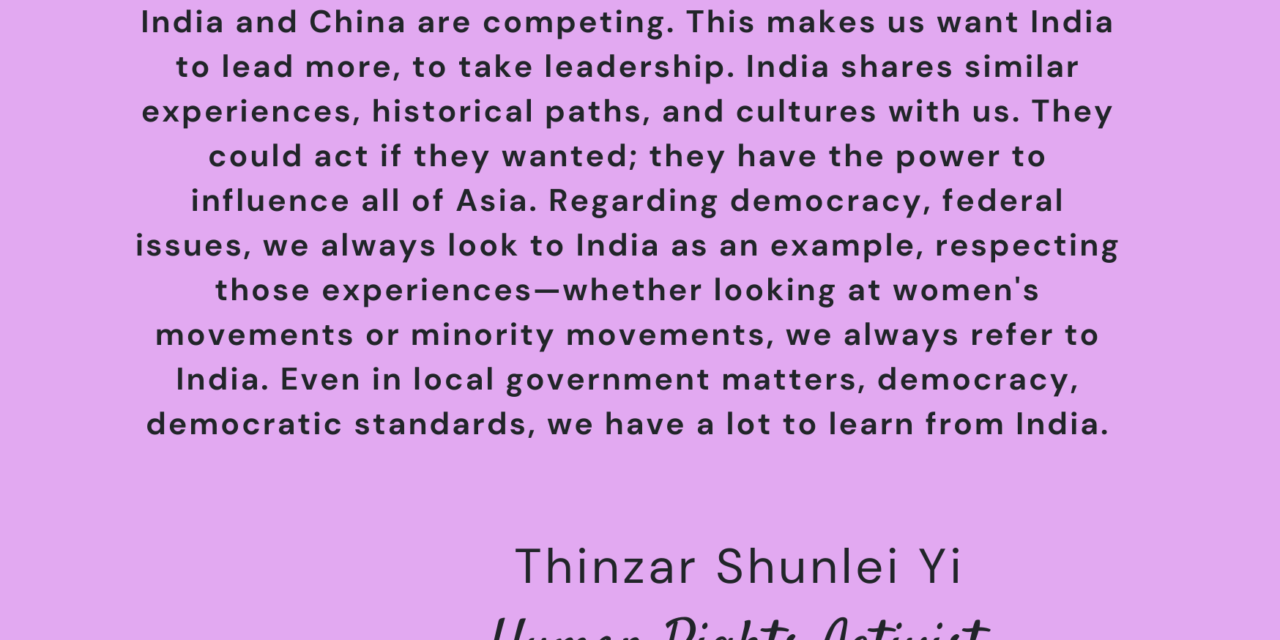
Thinzar Shunlei Yi: India and China are competing. This makes us want India to lead more, to take leadership. India shares similar experiences, historical paths, and cultures with us. They could act if they wanted; they have the power to influence all of Asia. Regarding democracy, federal issues, we always look to India as an example, respecting those experiences—whether looking at women’s movements or minority movements, we always refer to India. Even in local government matters, democracy, democratic standards, we have a lot to learn from India. However, when India does not take the leadership it deserves, while China’s challenge is faced by other smaller countries, now China is moving very swiftly. So, as Ko Dokhar said, China has already stepped on both sides. Because it has been stepping on both sides for many years, even if one side slips away, Chinese influence will remain. The people may or may not accept it, but the revolutionary forces led by the people are already contained. But India, I’m talking about the position where it can exert influence or provide leadership. Only if it acts truly and genuinely will they follow future influence and leadership. I think India is best positioned to provide leadership. However, does it have the political will to go that far? I don’t see the political desire. Not just for Myanmar, but across Southeast Asia, all of South Asia, I want India to reach a position where it can genuinely lead other countries in democracy and federalism. In terms of capability to do so, I think the Indian people have it. Regarding the current government’s considerations, I think the Indian people themselves should be educated and mobilized about these issues.
Editor-in-Chief: Yes, currently, whether neighboring or ASEAN countries, when their interest in Myanmar politics is purely self-interested, if our revolution were to succeed, what do you think Myanmar’s foreign policy should become? Please analyze that.
Thinzar Shunlei Yi: It’s true that countries must prioritize their own people and country. Think of your own home. But even if your home is rich and prosperous, if the neighborhood you go to, the main road to the street corner is broken. Many also practice a neutral policy. Why do they practice that? Because they lack advice on how to stand, on which issue to take what position comes from principles, principles and standards, values come into play. So, countries that lack strong standards, values, and principles are always neutral. Whatever they do, they remain neutral, whatever they do, they don’t know how to speak, don’t know how to discuss, don’t know where to stand, don’t know if it’s left, right, or center. That’s why they become neutral. Now Myanmar also suffers greatly from this. No matter how much fire is burning at home, the surrounding countries say don’t interfere, you know? We say in our neighborhood, you know, don’t interfere, you know? Even though killing is happening there, they say don’t interfere and just sit and watch from below. If, upon seeing injustice, you don’t try to step in and stop it, then you are complicit. The thinking that these events are inherently shared is spreading. So, what I see later is that when discussing foreign policies in the future, I think looking out only for one’s own country is too narrow and means no country exists. So, we must look at the surroundings, look at humanity. Take a country like Timor-Leste, you know, many don’t even know where Timor-Leste is. But from such a small country, their president stands up for us, that much is enough. No matter how small, when others stand up for us, it gives strength. I also want countries to be ones that include such considerations. I think we should practice this pattern from now for our future country.
Editor-in-Chief: Finally, what I want to discuss is that currently, regarding the Myanmar issue, we are completely ignored, and besides being ignored, there are treatments that slightly favor the military junta, relationships that give legitimacy. When we experience the consequences of this, from the people’s perspective, it’s a situation where increasingly tragic and terrible things are faced. In the past months, after the summit held in Thailand, because the military junta was invited, following that, the military junta’s actions have become more brutal. How do you want to encourage the people? Can such actions by the international community push our current revolutionary needs towards worrying situations? What do we need? How can we draw strength? Please discuss and analyze.
Thinzar Shunlei Yi: Our people must start opposing from our own homes. If our sisters, family members are being oppressed in our homes, we ourselves must ensure we don’t become oppressors. Then, we must speak out against oppression as we see it. We must stop the oppressor, halt the oppressor. So, if we start that culture from home, it will become neighborhoods, schools, workplaces, countries. What I see is that our people’s future is in our own hands. What we are experiencing today is never constant, always changing, will change. We also have the ability to make change happen. So, what we want tomorrow starts with what we do today. In today’s time, benefiting our surroundings, our family with what we can. If we are opposing unjust ideas, authoritarian systems from our own homes as mentioned earlier, I see us on the right path. No matter how alone you are, you can continue to stand, continue to act, continue to go. So, even if it’s one person against the whole world, one country against the whole world, from the belief that we must continue forward, I see that for our future new generations, at least in our own homes, there will be no more dictators. I think we can go on like that.
Note: This translated text represents our effort to help international observers of Myanmar affairs gain a more accurate understanding of the actual situation in Myanmar. If there are any shortcomings in the translation, we respectfully request that you consider the original Burmese meaning as the authoritative version.
 English