
Salai Do Khar: For this week’s exclusive interview, we have arranged to meet with a comrade from the Student Armed Force (SAF), a revolutionary organization formed by university students. We invite everyone to watch and support this interview from start to finish. First, I’d like to express my gratitude to Comrade Nwe for taking the time to speak with us. My first question is: Historically, student organizations have often been at the forefront of peaceful protests, pointing out the government’s mistakes or expressing dissent. However, apart from the All-Burma Students’ Democratic Front (ABSDF) formed during the 1988 uprising, we haven’t seen many student-led armed movements in recent times. So, could you share your perspective on the current revolutionary situation and explain why and how SAF chose to adopt an armed revolutionary approach?
Comrade Nwe: Yes, thank you. When the coup happened, not only students but the entire public rose up in opposition. As you mentioned, student unions have always stood with the people, critiquing and pointing out flaws in the government’s actions even before the coup. When the military seized power, students, along with the public, were at the forefront of the resistance, taking to the streets to protest. However, we came to realize that protests alone wouldn’t suffice to achieve our goal of returning power to the people. The enemy we face is a well-organized, heavily armed military that systematically oppresses opposition.
During the initial public uprisings, the military brutally suppressed protests, leading to significant loss of life. They attempted to crush any form of resistance with force. At that point, we, as students, began to understand that continuing with the same approach wouldn’t lead us to our goal. The military holds power through weapons, so to reclaim that power for the people, we needed to confront their organized, entrenched military structure with equal resolve. That’s why we, as students, chose the path of armed revolution. We understood that to overthrow the enemy, the traditional methods were no longer sufficient, and the armed struggle became a necessary choice.
Salai Do Khar: Comrade Nwe, you’re a woman and still at an age where you’d be attending university, which means you’re quite young. Not only did you choose to join the armed revolution, but what roles do you currently hold in the organization? And what challenges have you faced in those roles?
Comrade Nwe: Currently, I’m responsible for handling communications and alliance relations within our force. These responsibilities were assigned to me after our recent conference. As for challenges, they come in two parts, given my dual roles. In communications, our main task is to engage more effectively with the public. In terms of alliance relations, since the coup, numerous armed groups have emerged—some based on geographic regions, others on ethnic identities, and some driven by ideology. SAF, for instance, is built on the identity of students.
With so many armed groups, we share a common goal: to dismantle the military dictatorship. However, one major challenge is that, even if we succeed in overthrowing the military, we haven’t yet had thorough discussions about how these groups will return power to the people or what kind of agreements we’ll establish moving forward. This lack of clarity, in my view, limits the progress of the revolution. The military council still holds legitimate power and remains the most organized and dominant force. If revolutionary groups cannot present a unified, agreed-upon system to fill the power vacuum after the military’s defeat, it will make our fight much harder.
There’s also a concern that without prior agreements, we risk internal power struggles among revolutionary groups once the common enemy is gone. So, the biggest challenge right now is figuring out how these allied groups can negotiate, reach solid agreements, and establish a framework for the future. That, I believe, is the greatest challenge we face at this moment.
Salai Do Khar: I’d like to ask about your personal experiences. As a woman holding a significant role, working to build relationships with a diverse range of organizations, have you, Comrade Nwe, faced any additional challenges due to your gender?
Comrade Nwe: Yes, there are challenges. When we first formed the armed force, the structure itself posed difficulties. Whether as a woman or as someone coming from a student union background, I see the military as the epitome of a patriarchal organization. When fighting such an entity, we had to create another armed force to counter it. This situation inherently marginalizes groups like women, queer individuals, and others. Serving in such an environment is, to some extent, challenging. My current responsibilities involve soft power roles, like communications and alliance-building.
However, in a military context, where fighting is prioritized, patriarchal values often dominate. Combat roles tend to take precedence. That said, in recent times, many revolutionary forces, including those with strong structures, have been working to enhance the roles and capabilities of women. They’re promoting greater participation, even in revolutionary armies. Unlike traditional militaries, we’re building a revolutionary force with established principles and values. Many groups are making efforts to ensure that marginalized communities, like women and LGBTQ individuals, have their voices heard and their roles recognized, even in combat. For example, women are increasingly involved in operations like drone warfare.
Despite these efforts, the military structure inherently carries a patriarchal system. Overcoming these norms remains a challenge for women in all forces. Initially, women were a minority, which led to experiences of oppression and harassment within some groups. Early on, issues like conflict-related sexual violence in combat zones and sexual harassment outside of them were significant. Many women faced harassment, especially when networks and mechanisms weren’t yet established. We’ve heard some of these stories, while others remain untold. These are among the biggest challenges we face. To address this, there’s a need to establish robust accountability mechanisms. Women in these spaces are actively working to build and operate such systems.
Salai Do Khar: Recently, we’ve noticed discussions about disunity or differing perspectives among revolutionary groups. Many point out that in key decision-making spaces like the NUG or NUCC, youth participation seems limited. There’s a perception that the aspirations of young people leading the revolution on the ground differ from those of older leaders. So, based on Comrade Nu Wey’s experience, in our current revolution, are there differences in the approach to the revolution between the older generation and the younger generation? Do you see differences in the political systems we want to shape for the future?
Comrade Nwe: When the revolution began, it was often described as being led by Gen Z. But in reality, it wasn’t just Gen Z—it was people of all ages making their own decisions to take to the streets. However, as the revolution shifted to an armed struggle, many young people chose this path. Proportionally, the majority of those involved in the armed revolution are youth.
Yet, the decision-makers in the current revolutionary landscape are often not young people. As a result, the voices of youth—what they think and want—are not being adequately expressed. Their role is gradually diminishing. Despite youth making up roughly 80% of the revolution’s participants, their ideas and input in decision-making processes are limited. This is a gap I observe.
Salai Do Khar: Regarding SAF’s relationship with the NUG, we’ve noticed efforts to rebuild closer ties. How does SAF plan to work with the NUG toward the revolution’s goals? Can you share any specific agreements or areas of collaboration?
Comrade Nwe: From the start, we recognized the NUG as a leading organization in the revolution. We’ve had discussions with NUG representatives in the past. After our recent conference, SAF has been working to strengthen coordination, particularly in regions like Magway, where we’re active. We’ve agreed to collaborate with other groups on military operations and to discuss sharing revolutionary funds and resources. These were some of the outcomes of our latest meetings.
Salai Do Khar: So, now I’d like to discuss with Comrade New: given the current situation, with the military council planning a sham election, how are their efforts perceived in the areas where SAF and its allies operate? What’s the public’s view, and do you think the military’s election plans are feasible in territories controlled by revolutionary forces and in the areas where the student army and allies operate?
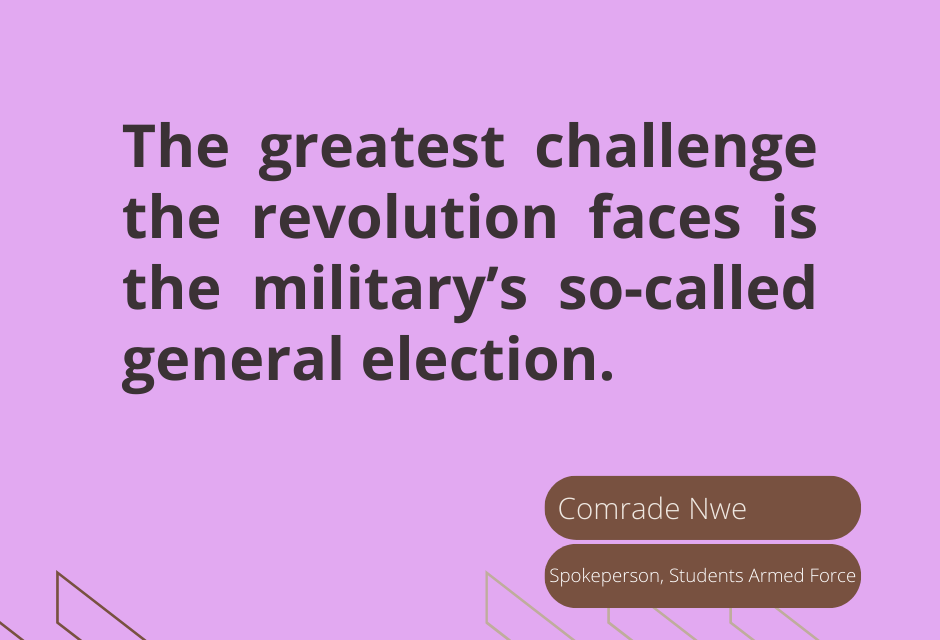
Comrade Nwe: The greatest challenge the revolution faces is the military’s so-called general election. Since about the beginning of this year, the junta has been trying to bolster its military strength through conscription laws while seeking political legitimacy through this election. Internationally, groups like ASEAN and the UN have rejected the idea of this election. Domestically, the military will likely try to expand its control over territories before the election to hold it in as many areas as possible.
On our side, revolutionary forces must ensure we don’t lose the territories we’ve secured. Even if the junta manages to hold an election, it would likely be limited to major cities they still control. Furthermore, in areas where only revolutionary forces are present, bombing attacks are continuous. The public understands that this election won’t advance our goal of ending the military dictatorship. Both revolutionary forces and people in controlled territories recognize this clearly. Our current focus is to prevent these areas from participating in the election and to strengthen our control over them. Allied forces need to collaborate to ensure the election doesn’t succeed. We’re discussing how to counter this move, maintain our momentum, and ensure our forces survive this challenge. To do so effectively, as I mentioned earlier, we need strong, agreed-upon frameworks among revolutionary groups to counter the junta’s political legitimacy and maintain territorial control. Our force is also preparing to counter this assault of the election with these two lines of action.
Salai Do Khar: Many political analysts criticize the NUG for its centralized structure and lack of intermediary state-level governments. SAF, for instance, primarily operates in Magway Region. Do you believe that the emergence of councils and governments in ethnic regions, organized as federal units, strengthens the revolution? On one hand, organizing by federal unit can make the force stronger, but on the other hand, for example, in Chin, they face fragmentation; in Sagaing, they encounter many differences of opinion and are dealing with them; in Magway Region, from what we hear, they are also facing some challenges. So, when forming a federal unit-based government or coalition, whether political or organizational, what things should be avoided, and what approach do you think would be best?
Comrade Nwe: From what I observe, in Sagaing, for example, they’ve drafted a constitution and are working to establish federal units. In Magway, discussions on this are also likely to take place. Sagaing has followed a certain format, and we see efforts to establish governance structures within federal units. In Magway, the population isn’t just Bamar; there are also Shan, Chin, and other ethnic groups, including local ethnic armed forces. Each group has its own goals and slogans based on their established frameworks, which may differ. These differences need to be addressed through dialogue.
When we can align the aspirations of these ethnic groups—Bamar and others—and create a cohesive structure, the revolution becomes stronger and more unified. However, caution is needed. Some organizations cling to their existing frameworks or political bargaining positions without engaging in genuine compromise. Others rely on pre-existing legitimacy to push their agendas. This creates significant problems. The best approach is to understand the ground realities and the desires of the local people. Each region has organizations representing the public, but their legitimacy depends on how well they’ve built trust on the ground.
Without thorough political discussions with these groups, imposing a single solution won’t work. There will be differing views on what constitutes the right approach. Only through earnest dialogue can we build a strong, unified unit. Otherwise, we risk counter-revolutionary dynamics emerging on the ground. So, if forces are trying to unite, they really need to have thorough political discussions. And during such discussions, one’s own bargaining position… So, my understanding is that when discussing, compromise is needed. It’s necessary to mediate and negotiate between what one wants and what the existing organizations want.
Salai Do Khar: Yes. Finally, I’d like your analysis on this: At the start of the revolution, many armed groups believed it would end quickly, within months, and planned to lay down arms afterward. However, these groups have since developed policies for long-term resistance. SAF, compared to others, emerged more cautiously and later. Did the initial assumption of a quick victory lead to disorganization in the armed revolution? Or is the issue rooted in the leadership of key entities like the NUG or NUCC? Regarding that, as a final remark, how would you analyze and suggest we can improve our revolution?
Comrade Nwe: As I mentioned earlier, when we chose the path of armed revolution, from the very beginning of forming our organization, we held the view that we needed to build a strong, sustainable structure for the long term. Following this perspective, we prioritized creating a robust force and a cohesive organization. Initially, we faced challenges. Some people thought that short training courses and urban uprisings would be enough, underestimating the enemy. However, the enemy we’re confronting is a well-established, formidable institution. To fight such an institution, we realized we had to build a strong, disciplined structure ourselves, and we worked toward that goal.
More recently, I’ve observed that even groups that initially lacked strong organization are now gradually focusing on building more robust structures. In the context of fighting an armed struggle against the people’s enemy, everyone now understands and accepts the need for systematic organization. Another point is that we’ve consistently raised the issue of NUG reform. SAF has engaged with the NUG, holding meetings and offering suggestions on what reforms are needed. In the past, we even sent open letters to the NUG, depending on the context. Leadership weaknesses have indeed been a significant issue for the revolution.
As time has passed, as I mentioned earlier, when armed groups were not properly organized from the start and failed to function as cohesive units, problems arose, particularly in Anyar (central) areas. When an armed group lacks clear policies and methods, it becomes extremely dangerous. If the initial organization was weak, having weapons and power leads to predictable problems. These issues disrupt the revolutionary path. While everyone shares the revolution’s overarching goals, losing sight of those goals results in nothing more than an armed mob. These problems are currently hindering the revolution’s success.
You’ve probably seen reports/news about issues like taxation and drugs. These stem from weak organizational structures and poor centralized control. Such issues confuse the public participating in the revolution, making them question which revolutionary forces truly stand firm in their principles. The core problem lies in weak foundational structures. However, some groups are now working to address this, and there’s increasing discussion about the need for reform—what’s required, what’s happening, and what problems exist. These discussions are becoming widespread. Even before now, people have consistently called for reform, emphasizing the need for change. What’s needed now is action.
So far, we haven’t seen much response to these calls, so action is crucial. As I’ve said, to truly unite, we need thorough political discussions and clear communication. The revolution has resources—public support and material assets—but if we can’t use them effectively, we’ll face more problems. Reforms must be carefully reviewed through clear policies. Regarding disarmament, SAF has a policy in place. We have five core principles and a vision and mission that guide why we’re fighting. If we achieve our goals, we understand that a disarmament process will be necessary. Our disarmament policy is based on our core principles, stance, and aspirations, and we’ll follow that process if we succeed.
Salai Do Khar: Given that this revolution, with all the complexities and successes, as this revolution moves toward its conclusion, could you share some words of encouragement for the public? Also, if you have any messages or invitations for people to join the Student Armed Force (SAF), please share them directly with the audience.
Comrade Nwe: Absolutely. From our perspective, the current phase of the revolution is highly sensitive. On one hand, the enemy is making efforts to consolidate power, both politically and militarily, to maintain their authority. On the other, there are international pressures. In this context, the entire revolutionary movement needs to overcome these challenges. I believe 2025 and 2026 are critical years for us. There are two key points I want to make. First, all revolutionary forces—both armed and non-armed groups—need to unite more cohesively. If we remain fragmented, the enemy’s efforts will succeed.
We understand that this is a crucial period for the revolution, with significant cracks and challenges emerging. To achieve our stated goals, the revolution must survive and navigate this phase. Revolutionary forces need to work together to find solutions to these challenges. Meanwhile, the public has endured immense hardships—war, earthquakes, natural disasters, and widespread crises. Despite these conditions, people continue to witness the junta’s actions, like airstrikes, and remain committed to resisting the military council.
However, if revolutionary groups fail to unite, the public—already strained by these crises—could become distanced from the revolution. To maintain public participation, we need to engage them more effectively. Revolutionary groups must listen to the people’s voices to overcome current challenges. We must never forget why this revolution began and what drives it. Existing groups need to address these difficulties and work collaboratively. Recognizing the flaws in our systems, people are already calling for reform, and groups must act to fix these issues. We also need to mobilize the public further. Given the critical military and political moment, we’re in, we invite the public to join us in any way possible. SAF has been sustained by public funding, and in the territories, we operate, people trust and believe in the revolution. Revolutionary groups must work to preserve that trust.
Additionally, regarding the role of youth, 90% of SAF consists of student youth. We have ambitions—military and political—and we invite students and young people outside to join us in the revolution. We’re building a robust force to ensure the revolution’s sustainability, and we need the energy of student youth to strengthen this effort. I invite them to join SAF and contribute to our path.
Finally, we urge the public to stand together to counter the junta’s election tactics. Revolutionary forces must focus on the people and the revolution’s goals to move forward. That’s what I want to emphasize.
Salai Do Khar: Yes. Thank you so much, Comrade Nwe, for giving us so much of your time and participating in this interview.
Comrade Nwe: Yes. Yes. Thank you, brother. I appreciate you for reaching out to us.
Note: This translated text represents our effort to help international observers of Myanmar affairs gain a more accurate understanding of the actual situation in Myanmar. If there are any shortcomings in the translation, we respectfully request that you consider the original Burmese meaning as the authoritative version.
 English