
Salai Dokhar: Greetings to all our viewers who always follow and support “The Kaladan Post”. This week, we have invited Padoh Saw Taw Nee, the spokesperson for the KNU, to discuss the current situation in Karen State, particularly under the leadership of the KNU, as well as the KNU’s stance on the international stage. First and foremost, I would like to express my deep gratitude to Padoh Saw Taw Nee for taking the time to join us today.
Padoh Saw Taw Nee:: Yes, thank you.
Salai Dokhar: Alright. My first question is about the current situation. The military junta has recently launched offensives and achieved some successes, accompanied by psychological warfare tactics that criticize the revolution and raise concerns about whether it can succeed. However, in Karen State, we don’t see much of this. The KNU’s leadership and mobilization efforts continue to be successful. Based on your experience, with the military junta seemingly regaining some ground, how real is their success in mobilization? What are the prospects for their success? Could you provide an analysis and discussion on this?
Padoh Saw Taw Nee: Yes, indeed. No matter how things unfold, revolutions always have their ups and downs, their highs and lows. For us, this isn’t anything particularly unusual. However, as we march forward on this long journey, the current situation we face isn’t unique. Many people are starting to notice that the military junta is launching counteroffensives, and there’s talk that the revolution has no path to victory. On one hand, the junta is heavily engaged in propaganda efforts. In reality, though, based on our experience, these are challenges we’ve faced throughout our struggle. As organizations firmly rooted in principled policies, no matter what challenges we face, we believe that unjust military regimes and authoritarian groups in our country have repeatedly collapsed, one after another.
We continue to stand firm. Even though the junta employs despicable and dirty tactics to sow division within our ranks, we remain united. Despite enduring such blows, an organization grounded in solid principles will, in the end, stand tall again when the time comes. This is something we’ve proven through our experience. Therefore, the actions of the military junta and their commissions today, even if done for propaganda purposes, will not succeed. We firmly believe that groups operating with injustice, even with overt or covert support from neighboring countries, cannot follow a righteous path. They create more harm than good, and ultimately, those who act unjustly will fall. This is our conviction.
If we compare the current situation to the Manerplaw era, we’ve made significant territorial gains. For instance, in Bago Region, along the Sittaung River, both the eastern and western banks, as well as the Yangon-Mandalay highway, are areas where our forces have been able to operate actively. Regarding transportation routes, the junta is desperately trying to regain control of the Asia Highway and National Highway No. 8 through large-scale operations, but these efforts involve clear interference from neighboring countries. Still, we believe we can withstand these challenges. Along the border, we control areas stretching over 1,000 kilometers. Currently, the junta is struggling to reopen trade routes like Myawaddy-Mae Sot, but they haven’t succeeded yet. Their efforts are mostly talk, with little progress on the ground. Regardless, we are confident that our revolution, rooted in truth, will prevail as long as we stand firm in our principles. Challenges and obstacles may arise, but we believe we can overcome them.
Salai Dokhar: Alright. In connection to that, while the junta is making some military advances, they are also talking about holding elections and seeking international legitimacy. Previously, countries like those in ASEAN, which strongly supported us, now seem to be warming up to the junta, and neighboring countries appear to be offering support as well. So, given the KNU’s governance in controlled areas and the current situation, do you think the junta’s proposed election is feasible? Could they effectively use it as a political maneuver or an exit strategy? Based on your experience, could you discuss this further?
Padoh Saw Taw Nee:: Yes. In terms of fighting, we are engaging in battles on multiple fronts. That’s certain. We’re waging political battles, military operations, and diplomatic efforts on the international stage. We will continue to work on cutting off all the junta’s revenue streams. Looking at it from another perspective, the people’s movement within our country cannot be suppressed by the junta. Whenever opportunities arise, the movement resurges. Given this reality, we’ve faced situations in the past where things seemed immovable. However, in this era, the junta’s attempt to use elections as their exit strategy or to gain legitimacy is heavily influenced by unjust interference from neighboring countries, as we’ve observed.
Nevertheless, these actions will lead to more harm than good. The junta may be trying to secure an exit or legitimacy, but in reality, the results won’t materialize as they hope. Why? Because the resolve of the people fighting against them is unwavering. No matter the challenges, our country has faced bitter experiences with authoritarian regimes for centuries, and we are determined to continue resisting. To neighboring countries, I want to say that supporting these unjust regimes, which oppress humanity and our people, will only create instability in our region. This instability won’t just affect our country but will have ripple effects on neighboring nations as well. Supporting military regimes in this manner is fundamentally wrong, and our decades-long struggle is proof of that. Therefore, there’s no reason to fear. We acknowledge that there will be ups and downs, but we will continue to fight. We firmly believe that truth will ultimately prevail. Despite the challenges we face, our strength lies in our resolute determination and unwavering policies that reject any authoritarian system. We will keep pushing forward.
Salai Dokhar: Alright. In your earlier discussion, you mentioned that neighboring countries are increasingly supporting the military junta’s actions. On the other hand, while the revolution initially received strong support, there are now growing criticisms regarding the lack of cohesive unity among revolutionary forces. So, my question is about the K2C and K3C, particularly the cooperation between ethnic revolution organizations (EROs) and the NUG. It’s understood that the KNU is leading efforts to consolidate these forces, including working toward a transitional government under the NUG. Could you share with the public, to the extent possible, the current status of these efforts and how much hope we can place in them?
Padoh Saw Taw Nee: What we’re working on now, particularly with K2C and the NUG, is crucial. When it comes to the transitional period, the so-called elections being pushed by the junta are based on the 2008 Constitution, which only serves to prolong the military dictatorship. That’s why we reject it. If we don’t accept it, we need to find an alternative path. Specifically, instead of relying on the 2008 Constitution, we need a new constitution that guarantees federal democracy, self-determination, and equality. During this transitional period, what’s truly needed is what we call the ” Article of Federal Transitional Arrangement” or a Federal Transitional Arrangement. Many groups are already coming together to draft this.
Among ethnic groups and revolutionary organizations, we’re seeing increasing unity. Other groups, such as political parties opposing the military dictatorship and its elections, are also joining hands with us. We are drafting a constitution to be used during the transitional period. We believe we can finalize this by the end of 2025. Once this constitution is in place, the elections we envision will be based on this transitional framework. Therefore, we reject the junta’s fake elections and are working toward an alternative—a federal democracy with guarantees. We’re committed to completing this process.
More groups will join us, and we will move forward together. We believe this will lead to genuine, sustainable peace. Compared to the past, we’re making progress step by step. Yes, there are challenges. In truth, we’ve been trying to do this for the past two or three years. Despite the challenges, we’re now making steady progress, and I can say we’ve come a long way. However, we still have further to go.
Salai Dokhar: In your discussion, you emphasized a firm political stance that the military junta’s system must be completely dismantled. Meanwhile, looking at the NLD’s statement on its recent anniversary, it briefly mentioned political dialogue, including with Daw Aung San Suu Kyi. On the other hand, some NUG leaders have indicated openness to dialogue if the junta makes political commitments toward reform. Some analysts argue that the revolutionary forces lack a unified, clear political goal and that this is a critical issue. How would you respond to this? Does the KNU believe there’s still a need to establish a clear, unified political goal among the major revolutionary forces? Is this part of the challenges you mentioned earlier?
Padoh Saw Taw Nee: Yes, that’s a critical point among the challenges we face, and we cannot ignore it. We will continue to coordinate and work together. We have no choice but to collaborate. No matter how big the challenges are, we cannot abandon this effort. As we move forward step by step, the core issue in our country is that political problems must be resolved politically. I’ve always believed this. That’s why, despite criticisms and attacks from many quarters, including those who say we shouldn’t talk with the junta or that there’s nothing to discuss given the bloodshed, we hear these voices.
However, we believe that political problems must be addressed through political means, and we’re not saying this without principles. We have clear principles. What are they? First, there’s a shared political goal among our groups: the military junta must completely withdraw from politics, and the military must transform into a truly professional institution. They must accept this. Second, they must accept a constitution based on federal democracy, which we’re currently working on. Third, during the transitional period, there must be justice. The military must be held accountable for its actions. We cannot simply forgive everything with our eyes closed. Internationally, those responsible for crimes must face justice, and we cannot blindly negotiate with such individuals. If they accept these three points, we are open to dialogue.
But our principles are already set. We’re not speaking without a foundation. If we are to talk with the junta, they must accept these three points. Only then will we engage. And when we talk, it won’t be about political negotiations for the sake of it. Our stance is firm. We will only discuss the military’s reform. That’s already established, and we will keep pushing forward. Each organization may have its own stance—whether their leaders are released or not, that’s their matter. But for us, we will wait as long as we can endure. If we can’t wait any longer, we will move forward. The situation demands that we act in sync with the times. These are the tasks we must undertake, and we’re doing them. I firmly believe we can succeed. I can say we’re making progress step by step.
Salai Dokhar: My next question is about your stance, which is clearly principled, fact-based, and firmly established. While not everyone may have formally signed onto these principles, they seem widely acceptable. Based on these principles, have you had the opportunity to formally engage in discussions with neighboring countries, ASEAN nations, or those pressuring for peace talks? Or is it still at the stage of issuing statements? Are there any positive responses or prospects for cooperation from some neighboring countries regarding these principles?
Padoh Saw Taw Nee: As mentioned earlier, our collaboration with K3C, K2C, and the NUG isn’t something new. It started back in 2022 when Indonesia was the ASEAN chair. The following year, it was Laos, and now Malaysia holds the ASEAN chairmanship. We’ve been consistently engaging with ASEAN, holding onto their Five-Point Consensus, particularly emphasizing that political issues must be resolved politically. The Five-Point Consensus, which Min Aung Hlaing himself agreed to in April 2021, is something he signed onto but then ignored, doing whatever he wanted. At that time, we didn’t reject the Five-Point Consensus outright. When we look at it, three key points stand out. The first is de-escalation—stopping violence and gradually reducing it to create a conducive environment for moving forward. That’s the primary foundation.
The second point is humanitarian assistance. When ASEAN provides humanitarian aid, it cannot only go to areas under the junta’s control. We control more territory than they do now. In our territories, over a million people are displaced and fleeing. Humanitarian assistance must reach these areas—it’s non-negotiable. The third point is inclusive dialogue, meaning all stakeholders must be included. We’ve been engaging with ASEAN based on these three points. We’re also in contact with like-minded countries such as Malaysia, Indonesia, and the Philippines. However, within ASEAN, differing policies and a lack of firm commitment create challenges. Still, when we talk about inclusive dialogue, as I mentioned earlier, we can’t immediately start talking with the junta. Our coalition includes groups from the north, south, east, and west—many different groups. As you said, getting every group to participate isn’t easy. But the key point is that once the major, critical groups are involved, the process will move forward. Why? Because we will talk. That meeting, specifically the first stage, requires a space for what’s called ‘Internal Dialogue’, where we revolutionary organizations sit down and talk amongst ourselves.
We’ve been telling neighboring countries this every time we meet. We tell powerful neighboring countries like Indonesia and those close to us that they must be involved and provide support. If they don’t, their approach of pressuring for ceasefires or engaging in trade and economic deals with the junta won’t be sustainable and will collapse. We’re pushing for inclusive dialogue, and we’re asking them to support our efforts. Only through this approach can we achieve lasting peace. We’re actively working on this. ASEAN’s rotating chairmanship changes yearly, so we need to keep pushing and adapting mechanisms to make progress. We believe these dialogues won’t conclude quickly—they require time.
The first and most urgent step is for the junta to stop all acts of violence. They’re still bombing daily. If you want to build peace quietly, you cannot solve it this way. Their fake elections, conducted while bombing continues, won’t lead anywhere. People will keep resisting. We believe in the path we’re on. We’re telling neighboring countries and the international community that if they don’t support these three critical points from ASEAN’s Five-Point Consensus, there’s no alternative path for us. We urge them to carefully consider this. Our country’s crisis isn’t just our problem—it affects neighboring countries and the world. Issues like drugs and scams, which are costing billions and exploiting entire nations, originate here. If they don’t support our principled approach to resolving this crisis, they’ll continue to face the consequences. That’s what we’re emphasizing.
Salai Dokhar: That’s very interesting, especially since among our neighboring countries, we have one democratic nation—India. However, we’ve noticed that since the 2021 coup, India has taken notable actions. For instance, at the junta’s Armed Forces Day, India sent high-ranking officials even before Russia or China did. Recently, Prime Minister Modi personally shook hands with junta representatives. At the upcoming BIMSTEC summit, India invited the junta, which even ASEAN and the UN have sidelined. India was also among the first to express support for the junta’s fake elections and is providing technical assistance. Given that refugees are entering India in large numbers and India is heavily affected by the drug trade, do India’s actions truly serve its own interests? How do you assess or respond to India’s actions in this context?
Padoh Saw Taw Nee: Yes. I want to point this out frankly. I’m not saying this out of resentment. Based on our Karen revolution’s history, starting in 1949, when we were just seven miles from Insein, Yangon it was the Indian government’s support that prolonged the life of the AFPFL government. That’s something our Karen revolutionary history can never forget. At that time, India was a single entity—neither Bangladesh nor Pakistan existed yet. That intervention pushed us further from urban centers, and we felt its impact deeply.
It doesn’t stop there. Over time, we’ve observed that, despite being a democratic nation, India has completely ignored and neglected the realities in our country. Particularly with fellow revolutionary groups like the Arakan revolution, with whom we’ve had ties for 40–50 years, we’ve faced significant challenges. For example, in the Arakan revolution, we supported figures like Major Khaing Moe Lin to return to Arakan from our headquarters to rebuild the revolution. We put in significant effort to help them establish the revolution in Arakan. But in the end, Major Khaing Moe Lin was killed before even reaching Rakhine Land.
It gets worse. As we worked together, particularly in regions like the Irrawaddy Delta and Bago Yoma, we tried repeatedly to make progress. In 1998, for instance, our Karen revolution collaborated with the Arakan revolutionary group, specifically with figures like General General Khaing Yar Zar and the Arakan Army (AA). However, their political organization was separate. In our KNU, we have our principles. While we were working hard on that, after breaking through and reaching the Bay of Bengal, our main intention was to reconnect with Arakan land and Karen land, specifically to break through back to the delta region which we had controlled for two decades of our revolution. But we were betrayed. Our leaders were lured, killed, or imprisoned in India for over 20 years. Only after a ceasefire did they release the remaining individuals, some of whom I personally met upon their return. We’ve had to overcome these experiences.
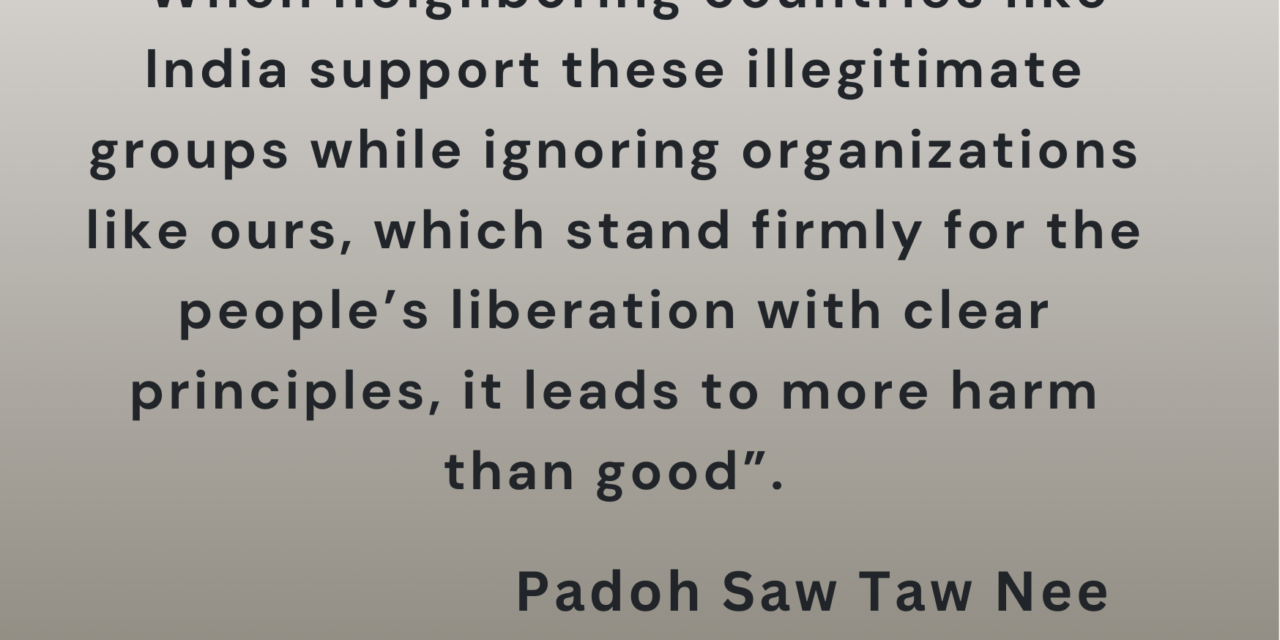
Yet, we understand that India accuses us of arming groups along its border or selling weapons. The truth is, no revolutionary group relies on external support for arms. No country or government provides us with weapons. We’ve had to acquire them through extremely difficult means to sustain our revolution. Now, post-2021 coup, with the junta’s mass killings, India was the first to support them. They’re now providing technical support for the fake elections. My point is that these actions won’t bring any real benefits to India. Even if they think they’re benefiting, history shows otherwise. Since independence, multiple governments have promised a federal union, but none have delivered—they’ve all been fake. When neighboring countries like India support these illegitimate groups while ignoring organizations like ours, which stand firmly for the people’s liberation with clear principles, it leads to more harm than good. I’m not saying this out of resentment but to highlight the truth.
If this revolution succeeds with integrity, we aim to build strong, genuine relations with India and all neighbors, regardless of their policies or whether they practice democracy. Our goal is sustainable peace without causing trouble for neighbors—be it drugs, refugees, or the massive scams that are now global. India can’t claim it’s immune to these scams either. These issues target and exploit nations. By supporting oppressive systems and illegitimate regimes, neighboring countries will face more negative consequences than positive ones. I urge India to carefully reassess its policies and work with groups like ours that have firm principles and genuinely want to improve this country. If they collaborate with us, the sustainable peace we envision for the future will become a reality. That’s what I want to emphasize today.
Salai Dokhar: As a final question, given that some people are experiencing psychological suppression and a decline in confidence in the revolution, what encouragement would you offer them? Could you, as a final note, share with our people, particularly about the hopeful future you envision?
Padoh Saw Taw Nee: First and foremost, I want to say that since 2021, the number of revolutionary groups has grown significantly. Before 2021, there were only about 20 revolutionary organizations, but now there are hundreds. Despite their diverse backgrounds and histories, we’re not standing still. We’re making efforts. For the sake of building a true federal union, groups with genuine commitment are working together. Even though some groups are difficult to engage directly, many of the principles we’ve been discussing are widely acceptable to them. What’s most remarkable is that, for the first time in history, the majority Bamar population is actively participating in the revolution to build a federal union. They’re striving to become true members of this union.
We’re seeing this in Sagaing, Magway, Mandalay, and other regions. These are real, positive developments. By joining hands and continuing to work toward building a federal union, we’re now at a stage where this vision is starting to take shape. After nearly 70 to 80 years, we’ve reached this point. So, I want to tell the public: there’s no reason to feel discouraged. The genuine federal union we’ve been yearning for is only now beginning to take form. For nearly 70 to 80 years, under successive authoritarian regimes and governments, we’ve lived with their lies and propaganda. There was never a true federal union—only empty talk about it, with no substance. From our grandparents’ time to our parents’ and now our own, after almost 80 years, we’re finally shaping this vision. This is a truly new step forward.
We can’t waste time on this journey. We must move forward step by step. This transformation is a real change for our country. What we want isn’t just a change of leadership or regime change—that won’t suffice for our country. To build a true federal union, we need a complete systemic change. That’s why we’re working on systemic transformation. Despite the challenges and disruptions, we’re moving forward with determination. Even if neighboring countries misunderstand us, now, as we keep working, they are beginning to understand us, and I believe this revolution will succeed within 4 years. I firmly believe that groups driven by short-term gains or money, without solid principles, will disappear quickly. Our efforts are rooted in a resolute commitment to building a federal union.
As we move forward, the international community will come to understand, and one day, with strength and resilience, we’ll stand firm and build this federal union. That’s the encouragement I want to offer. Don’t hesitate or look back. We need to keep moving toward what lies ahead. That’s my message of encouragement.
Salai Dokhar: Thank you so much, Padoh Saw Taw Nee, for giving us so much of your time and granting this interview.
Padoh Saw Taw Nee: Yes, thank you. I’m deeply grateful for this rare opportunity to speak and explain our position. I take great pride in it. Thank you very much.
Note: This translated text represents our effort to help international observers of Myanmar affairs gain a more accurate understanding of the actual situation in Myanmar. If there are any shortcomings in the translation, we respectfully request that you consider the original Burmese meaning as the authoritative version.
 English